Approximately 1,700 scientists visit SSRL annually to conduct experiments in broad disciplines including life sciences, materials, environmental science, and accelerator physics. Science highlights featured here and in our monthly newsletter, Headlines, increase the visibility of user science as well as the important contribution of SSRL in facilitating basic and applied scientific research. Many of these scientific highlights have been included in reports to funding agencies and have been picked up by other media. Users are strongly encouraged to contact us when exciting results are about to be published. We can work with users and the SLAC Office of Communication to develop the story and to communicate user research findings to a much broader audience.
Science Highlight Archive Science Highlight Banner Images
Illuminating the Multiconfigurational Ground State of Element and Intermetallic Compounds of U and Pu
The structural, electronic, and magnetic properties of U and Pu elements and intermetallics remain poorly understood despite decades of effort, and currently represent an important scientific frontier toward understanding matter.
SSRL Discoveries Point to Better Batteries
Energy storage materials, such as batteries, are of increasing importance in the modern world. They support the storage and distribution of electricity generated by different mechanisms, enabling the use of green power sources when the resource itself is unavailable (for example, solar energy at night or wind energy on a calm day).
Structural Basis of Wnt Recognition by Frizzled
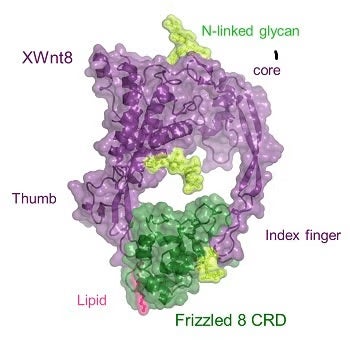
Wnts are a family of signaling proteins that regulate the development and growth of an organism, as well as tissue regeneration and wound healing.
SSRL X-rays Illuminate Frustrated Spin Liquid State
The electronic, spin, and ionic structures of closely packed atoms in solids are strongly co-dependent and interactions of these three lattices, whether innate or due to subtle manipulation, can cause exotic properties to emerge. The strong coupling among these lattices can also suppress a physical property through "frustration," the term for an incompatibility of symmetries.
Computational Design of Anti-flu Proteins
Understanding how proteins interact with some specific molecules and not with the myriad other molecules with which they coexist in every cellular compartment is a major goal of molecular biology.
Collaborate on Science Highlights
We can work with users and the SLAC Office of Communication to develop the story and to communicate user research findings to a much broader audience.