Approximately 1,700 scientists visit SSRL annually to conduct experiments in broad disciplines including life sciences, materials, environmental science, and accelerator physics. Science highlights featured here and in our monthly newsletter, Headlines, increase the visibility of user science as well as the important contribution of SSRL in facilitating basic and applied scientific research. Many of these scientific highlights have been included in reports to funding agencies and have been picked up by other media. Users are strongly encouraged to contact us when exciting results are about to be published. We can work with users and the SLAC Office of Communication to develop the story and to communicate user research findings to a much broader audience.
Science Highlight Archive Science Highlight Banner Images
Discovery of a Single Topological Dirac Fermion in the Strong Inversion Asymmetric Compound BiTeCl
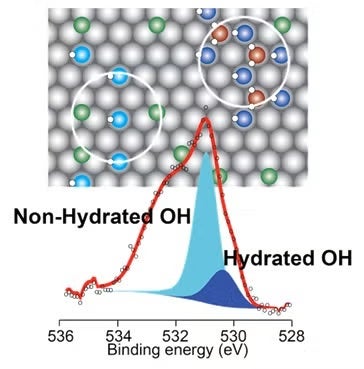
Direct Observation of the Oxygenated Species during Oxygen Reduction on a Platinum Fuel Cell Cathode
Using r-Space Phase Information in EXAFS to Characterize Possible Off-center Displacements in PbTe
Lead telluride, PbTe, is a well-known material used for its thermoelectric characteristics. In 2010, a research study suggested a new property: At temperatures above 100 K, the Pb atoms may become displaced from their usual locations in the crystal lattice (0.2 Å at 300 K), inducing Pb-Te electric dipoles in the material.
Percolation Explains How Earth’s Iron Core Formed
Earth’s inner structure is organized into layers. The outermost crust overlays the mantle, which, in turn, surrounds our planet’s core. The crust and mantle are mainly composed of silicate rocks. In contrast, Earth’s core is metallic, containing predominantly iron. But how did iron separate from the silicates in order to form the metallic core during Earth’s evolution?
Collaborate on Science Highlights
We can work with users and the SLAC Office of Communication to develop the story and to communicate user research findings to a much broader audience.