Materials Science
Developing new materials with tailored performance characteristics, which can be manufactured at scale, and which can be translated to industry an order of magnitude faster than the current state-of-the-art is crucial to addressing societal challenges in energy, information technology and human health. Materials Science research at SSRL cross-cuts a broad range of end-use application areas including electrochemical energy storage, hydrogen production and storage, clean fuels and chemicals, microelectronics, quantum materials and devices, drug delivery, bio-integrated devices, and advanced manufacturing. The expansive nature of this user program is unified through four key themes: developing fundamental understanding of how emergent behavior in materials and systems arise, developing fundamental understanding of synthesis and processing, understanding materials at work under intended end-use conditions, and accelerating materials discovery and optimization through integration of artificial intelligence/machine learning (AI/ML) with automated high throughput experimentation.
“Materials by Design” is a grand challenge goal in materials science. Achieving it requires understanding how a material forms, how it evolves during subsequent device processing or manufacturing steps, and how it dynamically responds to operating conditions. These relationships must be understood across a range of spatial and temporal scales, and in a myriad of environments. We are increasingly focused on integrating characterization capabilities with materials and device design pipelines, which has led to significant developments for in-situ and operando capabilities to support both synthesis science, and rationalizing materials and device behavior. The increased complexity of both in-situ/operando experiments and associated materials design spaces have motivated the development and implementation of AI/ML methods to aid in analysis and experimental design for complex measurements.
Materials for Energy
Unleashing the abundance of energy required to power modern life requires the development of new high performing materials, spanning sectors in energy generation and storage, separations and purifications, fuels and chemicals production, buildings, transportation, materials beneficiation, and manufacturing. To address this broad suite of challenges we work collaboratively with users to develop integrated multi-modal characterization approaches, bring the lab to the beam line, and accelerate knowledge generation through the integration of machine learning to experiments.
Strongly Correlated Quantum Materials
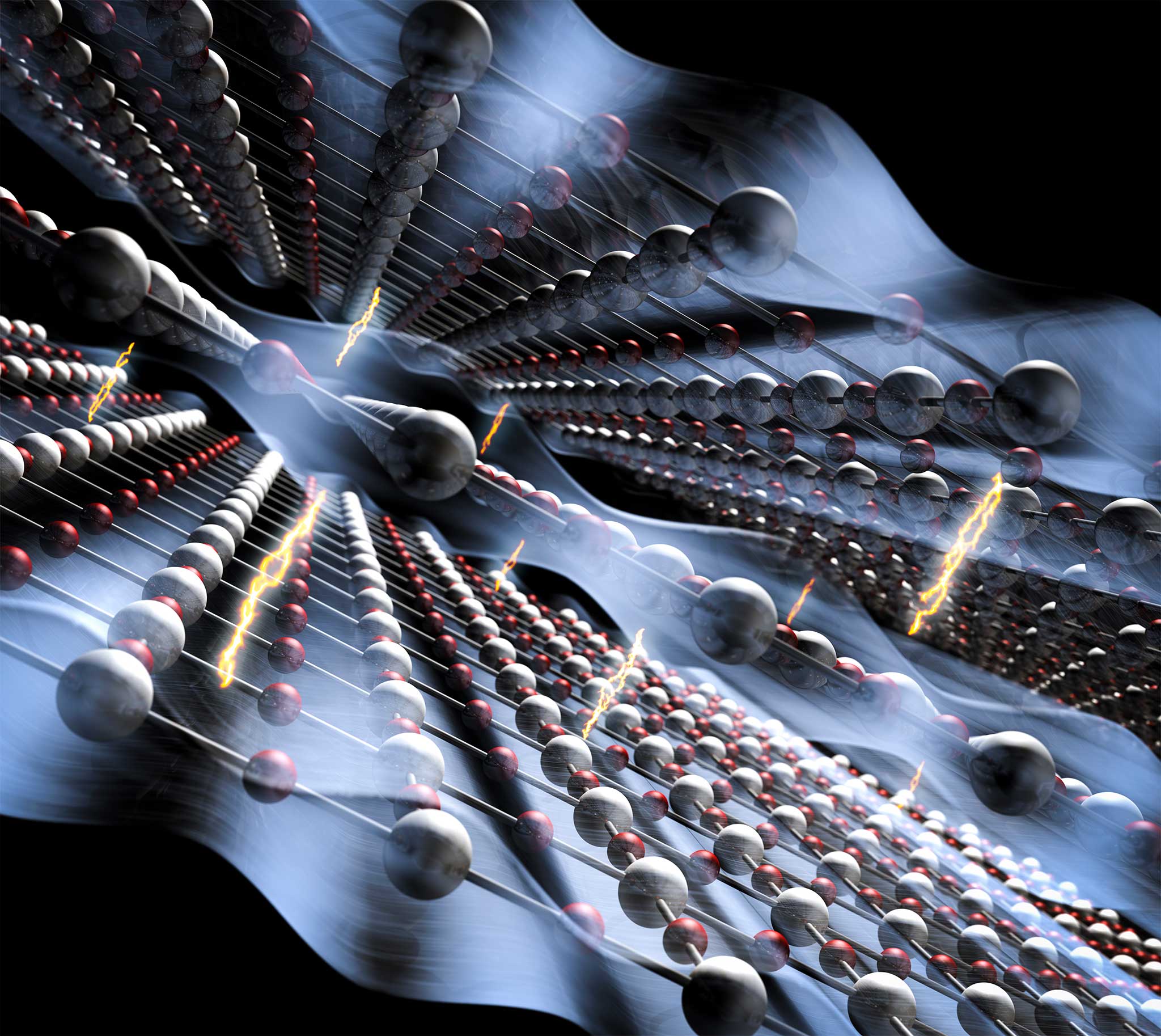
The emergent phenomena of quantum materials present exciting opportunities to understand and ideally control the transport of energy and information in strongly correlated electron systems. Creating and controlling the coherent transport of energy in condensed phase materials presents a compelling opportunity to greatly improve the energy efficiency of materials through the elimination of dissipative energy loss.
Microelectronics
Microelectronics research at SSRL is focused on understanding process-structure relationships for semiconductors, ferroelectric, ferromagnetic, multiferroic, and insulating materials. We focus on monitoring materials formation processes in-situ, and device performance in operando environments. As device complexity increases we will develop methods and advanced sample environments that enable understanding how processing of subsequent device layers impacts buried interfaces that are highly important to device performance.
Partnerships & Collaborations
Stanford Institute for Materials and Energy Sciences (SIMES)
The Stanford Institute for Materials and Energy Sciences (SIMES) addresses grand challenges in energy-related materials science through transformational research breakthroughs, advanced nanoscale understanding, and innovative instrument development. Leveraging Stanford and SLAC facilities, SIMES develops future leaders and creates cutting-edge materials solutions to drive energy independence, sustainability, and economic growth.


Theory Institute for Materials and Energy Spectroscopies (TIMES)
The primary objective of TIMES is to incubate and develop advanced theories and numerical algorithms, and perform the associated simulations for addressing cutting-edge problems in materials and energy sciences at advanced and next-generation photon facilities. TIMES focuses on three key research efforts centered on the creation and curation of modern codes and simulations for spectropscopy of novel materials.
Contacts & Resources
Donghui Lu
MSD Director
(650) 926-3026
dhlu@slac.stanford.edu
Johanna Nelson Weker
MSD Deputy Director, Hard X-rays
(650) 926-5565
jlnelson@slac.stanford.edu
Jun-Sik Lee
Soft X-rays
(650) 926-2219
jslee@slac.stanford.edu
Future Capabilities
| Science Themes | Spectroscopy | X-Ray Scattering | Imaging | |
|---|---|---|---|---|
| Strongly Correlated Electrons | ARPES | Undulator Beam Line; Diffractometer | STXM | |
| Energy: Photon Conversion and Batteries | Micro-Focus Spectroscopy | Advanced spectroscopy (X-Ray Inelastic Scattering) | Undulator Beam Line; Diffractometer | Upgraded TXM X-Ray Tomography |
| In-Situ Growth and Synthesis | Advanced spectroscopy (X-Ray Inelastic Scattering) | Undulator Beam Line; Diffractometer | Upgraded TXM X-Ray Tomography | |
| Picosecond Time Domain | Undulator Beam Line; Diffractometer | |||