Approximately 1,700 scientists visit SSRL annually to conduct experiments in broad disciplines including life sciences, materials, environmental science, and accelerator physics. Science highlights featured here and in our monthly newsletter, Headlines, increase the visibility of user science as well as the important contribution of SSRL in facilitating basic and applied scientific research. Many of these scientific highlights have been included in reports to funding agencies and have been picked up by other media. Users are strongly encouraged to contact us when exciting results are about to be published. We can work with users and the SLAC Office of Communication to develop the story and to communicate user research findings to a much broader audience.
Science Highlight Archive Science Highlight Banner Images
Water-Rock Reactions Produce Hydrogen Gas at Temperatures within the Limits of Life
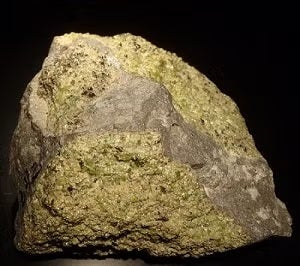
Hydrogen gas is produced in chemical reactions between anoxic water and iron-rich rocks at temperatures above 200°C – conditions too hot to support life.
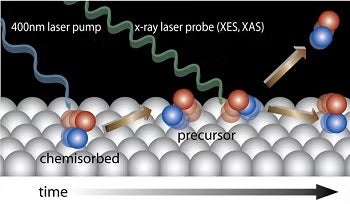
Element-Specific and Real-Time Observation of CO-Ru Chemisorption Bond Breaking with Soft X-ray Spectroscopy
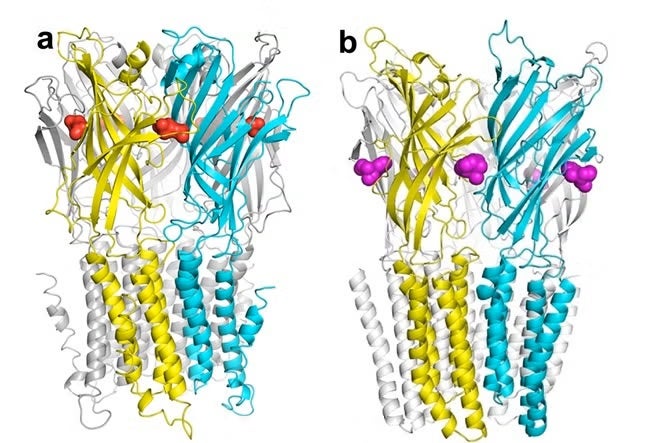
An international collaboration of scientists, including several from SSRL, has taken advantage of the broad range of photon science capabilities available at the lab to investigate a
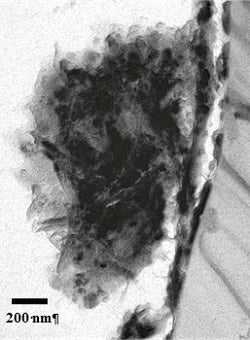
X-rays Illuminate a Microscopic Picture of the Correlation between Nitrogen-dopant Bond Type and Electronic Effects in Single-layer Graphene
Doping graphene with small amounts of another element such as nitrogen or boron enables scientists to "tune" its properties to make it more suitable for a variety of applications, such as contact material in solar cells.
Collaborate on Science Highlights
We can work with users and the SLAC Office of Communication to develop the story and to communicate user research findings to a much broader audience.