Structural Molecular Biology
Illuminating Biological Structures at the Atomic and Molecular Levels



Biological Small Angle X-ray Scattering/Diffraction
Beamline Hardware
Beamline Software
BL4-2 Hardware: Optics
Mirror
For focusing the synchrotron radiation onto the detector plane an upward reflecting water cooled torroidal mirror situated at the mid-point of the beamline between source (wiggler) and detector is used. The larger radius of the toroid responsible for the focusing of the beam in the vertical direction can be adjusted using a mirror bending mechanism to optimize the spotsize at the desires focal distance.The mirror is used to create a 1:1 image of the source at the detector position. Under typical operating conditions the horizontal acceptance of the mirror is reduced to 0.5 mrad (from a maximum of 1.5mrad) in order to keep the horizontal source size small. Under these conditions and with a nominal reflection angle of 3.6 mrad, the mirror produces a beam spot size of 0.2 x 1.0 mm2 (vertical x horizontal) in the detector plane. The mirror features a Rhodium coating for improved reflectivity which limits the useful energy range accessible at the beamline to < 17.5 keV.
Monochomator
The monochromator at the beamline selects the approriate energy band of the x-rays for the experiment. The one used at BL4-2 has two interchangeable pairs of liquid nitrogen cooled diffractive elements: a pair of Si(111) crystals for high energy resolution and a pair of Mo/B4C multilayers for high flux experiments. They are mounted on a Huber goniometer in a vacuum chamber and the desired diffractive elements for the experiment can be remotely selected.
- the Si(111) crystal pair is used for standard scattering and diffraction experiments at the beamline and provides a total flux of approximately 3x10¹² ph/s in the full beam (at 500mA SPEAR3 current) with an high energy resolution of ΔE/E ~10-4
- the Mo/B4C multilayer pair is currently mostly for fast time resolved experiments and provides a total flux of approximately 1x10¹⁴ ph/s in the full beam (at 500mA SPEAR3 current) with a energy resolution of ΔE/E ~0.02

Kirkpatrick-Baez (KB) focusing mirror module
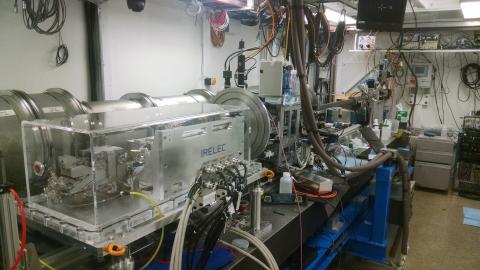
The KB system is an optional focusing module that enables SAXS data collection with beam sizes on the order of 50 µm in the focal spot which opens up the possibility to use sample conserving general microfluidic devices for sample delivery for the regular solution scattering experiments as well as microfluidic mixers for continuous flow time-resolved experiments. The mirror system (manufactured by IRELEC) features a 300 mm long horizontally and a 170 mm long vertically focusing mirror, each one mounted on a stable bender system originally developed at the European Synchrotron Radiation Facility. Both mirrors are mounted inside a helium tight enclosure on a common base plate and are operated in a helium atmosphere. The base plate has been custom designed to fit the layout of the beamline instrument to minimize the number of hardware components that need to be removed in order to install the module.