Approximately 1,700 scientists visit SSRL annually to conduct experiments in broad disciplines including life sciences, materials, environmental science, and accelerator physics. Science highlights featured here and in our monthly newsletter, Headlines, increase the visibility of user science as well as the important contribution of SSRL in facilitating basic and applied scientific research. Many of these scientific highlights have been included in reports to funding agencies and have been picked up by other media. Users are strongly encouraged to contact us when exciting results are about to be published. We can work with users and the SLAC Office of Communication to develop the story and to communicate user research findings to a much broader audience.
Science Highlight Archive Science Highlight Banner Images
Tailoring Plastics at the Molecular Level for Cost and Environmental Benefits in Industrial Processing
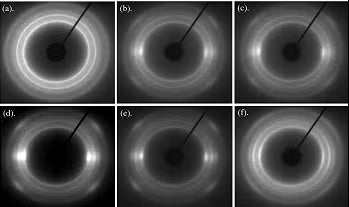
Much of our manufactured environment - many metals, plastics, glasses, ceramics, fiberglass and papers - consists of extrusion-molded products.
Looking at Trace Impurities on Silicon Wafers Using Synchrotron Radiation
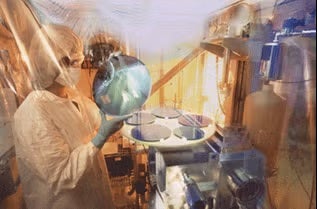
Increasing the speed and complexity of semiconductor integrated circuits requires advanced processes that put extreme constraints on the level of metal contamination allowed
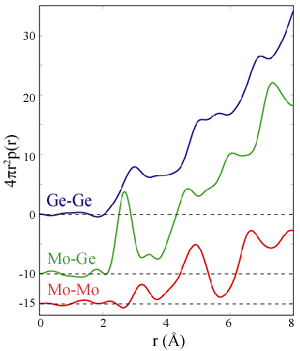
Enabling New Science with Advanced Beam Line Control and the Quantum-315 CCD Detector: The Ultra-High Resolution Structure of Nitrogenase MoFe-Protein
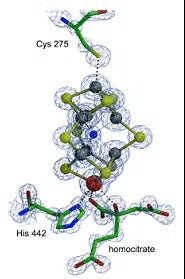
The Research group of Douglas Rees at the California Institute of Technology collected X-ray crystallographic data to a resolution of 1.16 Å at SSRL Beam Line 9-2 using the new Quantum-315 CCD
ABC Transporter Architecture and Mechanism
Transport proteins, embedded in lipid membranes, facilitate the import of nutrients into cells or the release of toxic products into the surrounding medium. The largest and arguably the most important family of membrane transport proteins are the ABC transporters.
Collaborate on Science Highlights
We can work with users and the SLAC Office of Communication to develop the story and to communicate user research findings to a much broader audience.