Approximately 1,700 scientists visit SSRL annually to conduct experiments in broad disciplines including life sciences, materials, environmental science, and accelerator physics. Science highlights featured here and in our monthly newsletter, Headlines, increase the visibility of user science as well as the important contribution of SSRL in facilitating basic and applied scientific research. Many of these scientific highlights have been included in reports to funding agencies and have been picked up by other media. Users are strongly encouraged to contact us when exciting results are about to be published. We can work with users and the SLAC Office of Communication to develop the story and to communicate user research findings to a much broader audience.
Science Highlight Archive Science Highlight Banner Images
Cross-β Structure - a Core Building Block for Streptococcus mutans Functional Amyloids
Amyloid, composed largely of mis-folded proteins that form insoluble fibrillar aggregates, is important to many human diseases including Alzheimer’s. Tooth decay also features amyloid-forming proteins, but in this case it is not mis-folded human amyloid proteins but bacterial proteins that are not mis-folded when they aggregate into functional amyloid polymers.
Reversible Cation and Anion Redox in Lithium-rich Sulfide Battery Cathodes
While steady improvement of lithium-ion batteries has allowed electronic technologies, like personal electronics and electric cars, to perform better, researchers are nearing a theoretical limit to lithium-ion battery capacity. One way to overcome this limit is to change the chemistry of materials to allow more electrons to exchange between anode and cathode per unit of material.
Cathode Enables Quasi-Two-Stage Intercalation for Multivalent Zinc Batteries
Because they are highly efficient, low maintenance, and light, lithium-ion batteries have grown in popularity. Their use has improved the functionality of many electronics, such as allowing our cell phones to be more portable and our electric cars to travel longer distances.
Design of Novel Protein Cages
Some proteins can form complex cage structures that can trap, hold, catalyze, and release small molecular and atomic cargo based on environmental signals. These protein cages are made of a collection of identical monomer proteins self-assembled into a symmetric conformation.
Shedding Light on Photoisomerization: Electrostatic Control of Excited State Reaction Pathways within Proteins
Organisms including microbes, plants, and animals can interpret light as a signal for action. While this is a fundamental and important process, the mechanism still holds mystery. How are photons converted into molecular signals? At the most basic step, a light-sensing molecule, a chromophore, undergoes a conformational change, an isomerization, when it encounters a photon.
Discovery of Topological Weyl Fermion Lines and Drumhead Surface States in a Room Temperature Magnet
Physicists have been interested in crystalline materials where the quantum mechanical behavior of electrons is governed by topology, so-called topological quantum matter. Recently the community has been particularly excited about crystals which additionally exhibit magnetism, i.e. topological quantum magnets. What new topological behavior might such magnets exhibit?
Electronic Nematicity without Magnetism in FeSe
In superconducting materials, electron clouds can align into a specific order termed nematicity, a word taken from a root meaning string-like and previously used for alignment of molecules in liquid crystal displays (LCDs). Most iron-based high temperature superconductors (FeSCs) exhibit nematic order and magnetic order in conjunction with superconducting behavior.
Direct Imaging of Metal Additive Manufacturing Processes
3D printing is revolutionizing the manufacture of products, promising fast and inexpensive ways to make quick prototypes, small batch parts, and unique pieces exactly to specifications. The uses for 3D printed metal range from specialized car parts to custom medical prosthetics.
A Spider Toxin Catches a Sodium Channel Involved in Pain Perception in Action
Nerve, muscle, and heart cells are activated by the influx of sodium ions into the cells causing an increase in positive charge inside cells. In a carefully regulated system, sodium passes across cell membranes via a variety of sodium ion channels, which open during activation and close when not active. Nav1.7 is a type of sodium channel that has an important role in pain sensation.
Structure and Functional Binding Epitopes of V-domain Ig Suppressor of T-Cell Activation (VISTA)
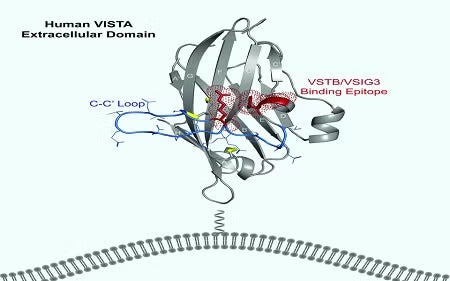
Implicated in human cancers including skin, prostate, colon, pancreatic, ovarian, endometrial, and lung, the protein called VISTA (V-domain Ig Su
Collaborate on Science Highlights
We can work with users and the SLAC Office of Communication to develop the story and to communicate user research findings to a much broader audience.