Approximately 1,700 scientists visit SSRL annually to conduct experiments in broad disciplines including life sciences, materials, environmental science, and accelerator physics. Science highlights featured here and in our monthly newsletter, Headlines, increase the visibility of user science as well as the important contribution of SSRL in facilitating basic and applied scientific research. Many of these scientific highlights have been included in reports to funding agencies and have been picked up by other media. Users are strongly encouraged to contact us when exciting results are about to be published. We can work with users and the SLAC Office of Communication to develop the story and to communicate user research findings to a much broader audience.
Science Highlight Archive Science Highlight Banner Images
High Resolution Structure of the Neisseria gonorrhoeae Type IV Pilus: A Membrane-bound Fibrous Assembly
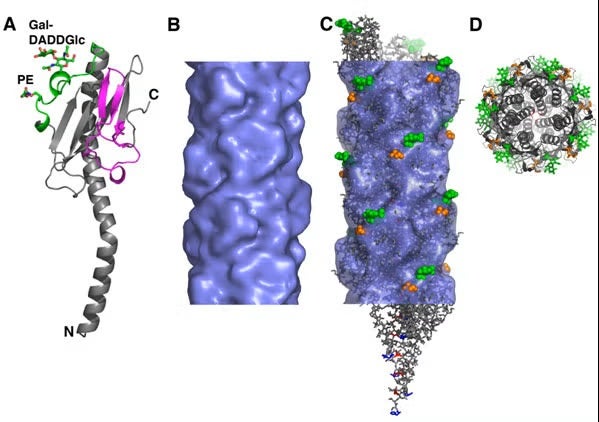
A team of researchers working at SSRL has determined the atomic structure of an assemblage of fiber-forming proteins found in the cell membranes of many dangerous types of bacteria.
Molecular Interaction between Botulinum Neurotoxin B and Its Protein Receptor Revealed
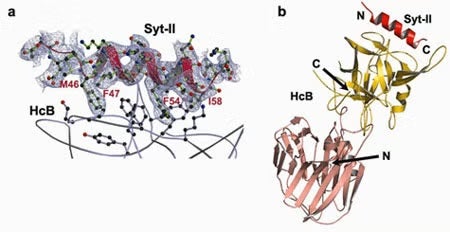
Botulinum neurotoxin is produced by the bacteria Clostridium botulinum and is the most potent toxin known, inducing a potentially fatal paralysis known as "botulism." Botulism
Ancient Warriors and the Origin of Chinese Purple
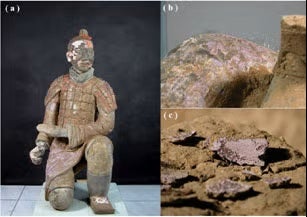
In 1974, while sinking irrigation wells in the Chinese province of Shaanxi, a group of farmers made an astonishing archeological discovery.
Multiple Reference Fourier Transform Holography: Five Images for the Price of One
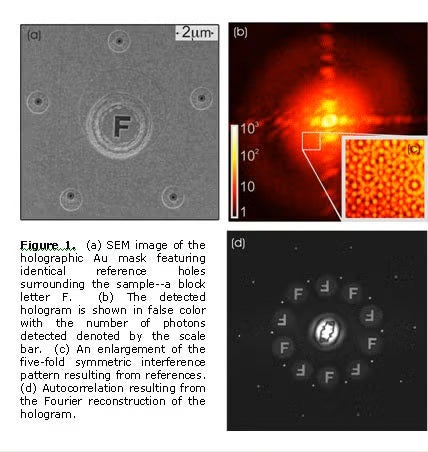
Scientists at SSRL have demonstrated a novel approach for improving the efficiency of an x-ray microscopy technique that may in particular prove beneficial for imaging radiation-sensit
Delocalized Molecular Orbitals of the [6Fe6S] Cluster of the FeFe-Hydrogenase
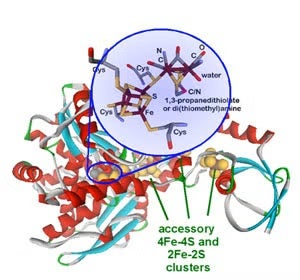
The FeFe-hydrogenases are of great interest because they can catalyze both the forward and reversed dihydrogen uptake/evolution reactions.
Femtosecond Lattice Dynamics in Photoexcited Bismuth
In a recent experiment performed at SLAC and reported in the February 2 issue of Science, David Fritz and his SPPS colleagues have obtained our first direct view of the motion of atoms inside a crystal. This feat requires simultaneous Angstrom spatial and femtosecond temporal resolution.
A New Slant on a Cellular Balancing Act — the Copper-sensing Repressor of Mycobacterium tuberculosis
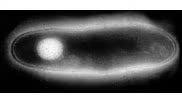
Scientists have discovered a gene for a protein that regulates the cellular response to copper in the bacterium that causes tuberculosis.
Structure of the MTIP-MyoA Complex, a Key Component of the Malaria Parasite Invasion Motor
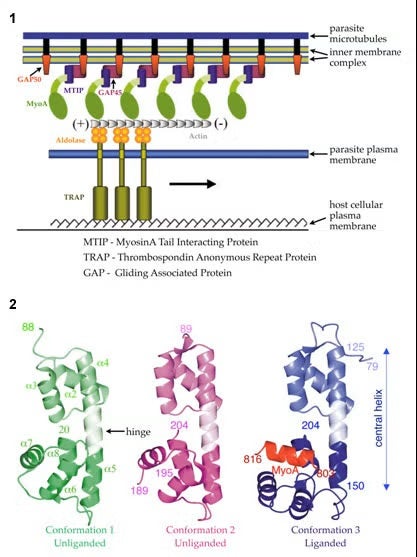
Researchers from the University of Washington working at SSRL have solved the structure of a protein complex that may one day be exploited to combat drug-resistant strands of the parasite that
Pseudogap and Superconducting Gap in High-Temperature Superconductors
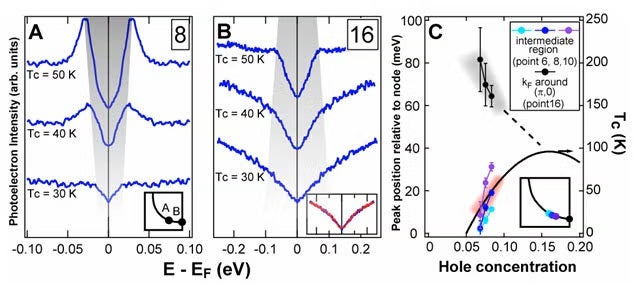
Scientists at Stanford University have recently made an important discovery about the coexistence of two distinct energy gaps in photoemission spectra of high temperature superconductors.
Collaborate on Science Highlights
We can work with users and the SLAC Office of Communication to develop the story and to communicate user research findings to a much broader audience.