X-ray diffraction

Synchrotron Mesodiffraction: A Tool for Understanding Turbine Engine Foreign Object Damage

Aircraft turbine engines are prone to ingesting pebbles and other debris that can damage jet engine fan blades, dramatically reducing the longevity of the components - sometimes catastrophically. Failures associated with such "foreign object damage" cost the aerospace industry an estimated $4 billion a year. Studies at SSRL have helped show how and why fan blades - which normally experience significant stresses during flying - fatigue sooner than expected from foreign object damage.

Following a Structural Phase Transition in Real Time with Atomic Spatial Resolution

When a snowball melts, you can tell it has achieved a liquid state when the frigid water drips through your fingers. But if you could follow the melting process, driven by the heat of your hand, from its very first moments - the first trillionth of second, would you be able to point to the exact moment the snowflake crystals disorder into liquid H2O? That's the challenge facing researchers using the Sub-Picosecond Pulse Source (SPPS) to probe the activities of materials on ultrafast timescales. SPPS makes intense x-ray pulses lasting quadrillionths of a second (femtoseconds), enabling researchers to directly monitor the earliest atomic changes during melting with ultrafast x-ray diffraction.

Highly Oriented Crystals in Polythiophenes

Stanford Synchrotron Radiation Laboratory (SSRL) and Stanford researchers have now shown that the electrical performance of plastic semiconductors can be controlled and improved with surface treatments. In their research, published in Nature Materials, they showed they could align the small crystals within the polymer by applying a thin layer of another kind of organic molecule on to the surface. The highly-oriented crystals give the material better performance in conducting electricity. Researchers used x-ray scattering facilities at SSRL to determine the orientation of the crystals.

Femtosecond Diffractive Imaging with a Soft-X-ray FEL

Scientists have for the first time used an extremely short and intense coherent soft x-ray laser pulse to successfully obtain a high-resolution image of a nano-scale object before the sample was destroyed by the energy impact of the pulse. The experiment, conducted at Deutsches Elektronen-Synchrotron (DESY) in Hamburg by a collaboration that included researchers from the Photon Science Directorate at SLAC, also set a speed record of 25 femtoseconds for the duration of the x-ray pulse used to acquire the image. The results are published in the November 12 online edition and the December printed edition of Nature Physics.

Effect of Chemical Pressure on the Charge Density Wave Transition in Rare-Earth Tritellurides RTe3

A collaboration between scientists at SSRL and the department of Applied Physics at Stanford University has determined the phase diagram of a new family of prototypical charge density wave (CDW) compounds. These compounds have the chemical formula RTe3, where R represents a rare earth element from La to Tm. In research, the collaborators have used X-ray diffraction and resistivity measurements to determine the factors affecting the symmetry of the CDW state, specifically whether the CDW runs in one direction or two.

Understanding Charge Transport in Plastic Electronics

Recent advances in materials research are setting the stage for macroelectronics to have a disruptive effect on everyday technology. While microelectronics focuses of the miniaturization of electronic devices (think of the shrinking iPod), macroelectronics is the replication and integration of microelectronic devices onto large areas such as display backplanes (big screen TVs and electronic billboards), large-area photovoltaics (flexible solar cells) and radio frequency ID tags. One class of materials that has demonstrated great promise as the semiconducting layer in these macroelectronics devices is polymer semiconductors, which allow for potentially inexpensive manufacturing from solutions.

Effects of Thermal Annealing On the Morphology of Polymer–Fullerene Blends for Organic Solar Cells

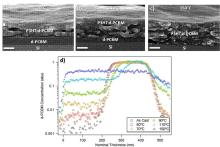
Organic solar cells, which use organic polymers or small organic molecules to convert sunlight into a useable form of energy, are a promising new tool for providing inexpensive, environmentally friendly energy. To date organic solar cells have demonstrated comparatively low rates of efficiency, stability and strength.  However, there is much room for improvement before the theoretical efficiency limits are reached.

Uncovering the relationship between the active layer structure and device performance in organic solar cells

Currently, organic or plastic solar cells are relatively inexpensive to make, yet they are also relatively inefficient. Researchers from Princeton University and SSRL recently studied the structure of organic solar cells that were manufactured and processed in different ways to better understand the causes of the inefficiencies.

Enhanced Charge Transport in Printed Small Organic Semiconductor Thin Films due to Strained Molecular Packing

Organic semiconductors could usher in an era of foldable smart phones, better high-definition television screens and clothing made of materials that can harvest energy from the sun needed to charge your iPod or iPad, but there is one serious drawback: Organic semiconductors, while inexpensive, do not conduct electricity very well.