X-ray diffraction

Resonant X-ray Reflectivity Study of Perovskite Oxide Superlattices
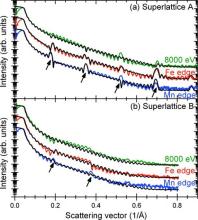
Materials that exhibit magnetism, superconductivity (the ability of electrons to travel without resistance across a material), and ferroelectricity (important for capacitors and used, for example, in medical ultrasound machines, infrared cameras and fire sensors) are the subject of significant scientific and technological research. These properties can depend strongly on the roughness of interfaces between layers as well as the thickness of these layers (often each a mere ~2.5 nanometers, or 1/16,000th the width of a human hair, thick); as such, the ability to characterize these layers at high-resolution is important.  Yet few characterization techniques exist that have the ability to characterize the structure and uniformity of such complex structures.

X-ray Characterization of Lithium-Sulfur Batteries in Action

Dramatic improvements in energy storage devices are essential to meet the increasing need to move away from fossil fuels and toward clean, renewable energy. Rechargeable lithium-sulfur (Li-S) batteries hold great potential for high-performance energy storage systems because they have a high theoretical specific energy, low cost, and are eco-friendly; but a better understanding of how the battery functions is required to design improvements for higher efficiency and capacity.

A General Relationship between Disorder, Aggregation, and Charge Transport in Conjugated Polymers

Films of semiconducting organic polymers are major candidates for new materials, with industrial applications ranging from lighting equipment to solar cells to electronic devices. In order to fully exploit these materials, scientists must first understand how polymer films transport electric charge.

Tunable Transmittance of Near-infrared and Visible Light in Reconstructed Nanocrystal-in-Glass Composite Films

Amorphous materials such as glasses have optical, electrochemical and transport characteristics that are closely linked to their inner structures. Modifying the structure of an amorphous material can create new properties that may be of interest for industrial applications. Recently, researchers have altered niobium oxide glass by inserting tin-doped indium oxide nanocrystals into its structure.

Putting the Spin on Graphite: Observing the Spins of Impurity Atoms Align

Carbon-based materials are extremely lightweight and have thermal, mechanical and electrical properties that are of great interest for use in functional devices. Carbon materials can be manufactured in virtually any shape and even with dimensions on the micro- and nanoscales. Recent research is now aimed at exploiting the spin and magnetism of carbon-based materials for data storage devices – a field called spintronics.

Multiscale Speciation of U and Pu at Chernobyl, Hanford, Los Alamos, McGuire AFB, Mayak, and Rocky Flats

When a geographical area is contaminated with radioactive elements, time and heat can cause them to combine with other atoms to form a variety of compounds. Knowing what compounds form and when they form is important for containing and cleaning contaminated sites. Computer models can make predictions but are limited to the currently known reactions and compounds that can be described in the laboratory.  A collaboration of scientists has taken samples from the fields of six different contaminated sites to discover which chemical species are formed from uranium and plutonium. The sites studied released these elements under different circumstances and into different environments.

Effect of an Ultrathin Coating on Stabilizing Li-ion Battery Cathodes

The widespread adoption of renewable energy in many applications, such as electric cars, is dependant on the development of better batteries. A lithium ion battery can be made to have a higher capacity, better thermally stability, and lower cost by changing the cobalt component of the battery cathode (usually LiCoO2) to a mixture of nickel, manganese, and cobalt. While providing great benefits, this material, known as NMC, also has a downside: increased reactivity at the cathode resulting in a shorter battery lifetime. To counteract this reactivity, scientists at the National Renewable Energy Lab in Colorado developed a coating for the NMC cathode.

X-ray Study Reveals How Silver-to-Silicon Contacts Form for Solar Cells

Most solar panels use technology that employs a silver-silicon interface. Because silver is expensive and the lead used in the creation of this interface is toxic, researchers are interested searching for other materials that could work instead of these components. A team of scientists are working to understand the process involved in the silver-silicon contact formation so that alternatives that perform the same function can be found.

Tuning the Properties in Perovskite Materials for Photovoltaics

The search continues for solar energy materials that are efficient and inexpensive and simple to make. Films made of metal halide perovskite crystals are good candidates because of their impressive solar cell efficiencies and their low cost to produce. An advantage of metal halide perovskite materials is the ability to tune their band gap, which determines the wavelengths of light that can be collected by the solar cell.