Lithium-ion batteries power our modern electronics, from smartphones to wireless earbuds, but their lifespan remains a challenge, especially under real-world conditions. While traditional lab tests provide insights into battery degradation, they often fail to capture how batteries behave inside actual devices, where they are exposed to varying temperatures, mechanical stresses, and different usage patterns. A research team led by Prof. Yijin Liu at UT Austin tackled this issue by using advanced X-ray imaging across different length scales to study battery failure in commercial wireless earbuds. Their findings reveal how environmental factors impact battery degradation, offering insights that could lead to longer lasting and safer batteries.
The team used high-resolution transmission X-ray microscopy (TXM) on beam line 6-2c at SSRL to visualize battery damage at the nanoscale, uncovering microscopic cracks, material breakdown, and chemical changes associated with degradation. Infrared imaging provided a complementary view, revealing how heat from surrounding electronics altered the battery's internal thermal environment. This created uneven temperature distributions across the battery, leading to accelerated wear and degradation in specific regions. Unlike the aging pattern observed in controlled lab environments, real-world conditions introduced localized stress points that significantly influenced battery lifespan.
To gain a more comprehensive understanding of these degradation mechanisms, researchers leveraged x-ray diffraction and spectroscopy capabilities at SSRL beam lines 11-3, 7-3 and 10-1 as well as additional synchrotron facilities at APS, NSLS-II, and ESRF. These facilities provided useful insights into the battery’s structural and chemical evolution over time.
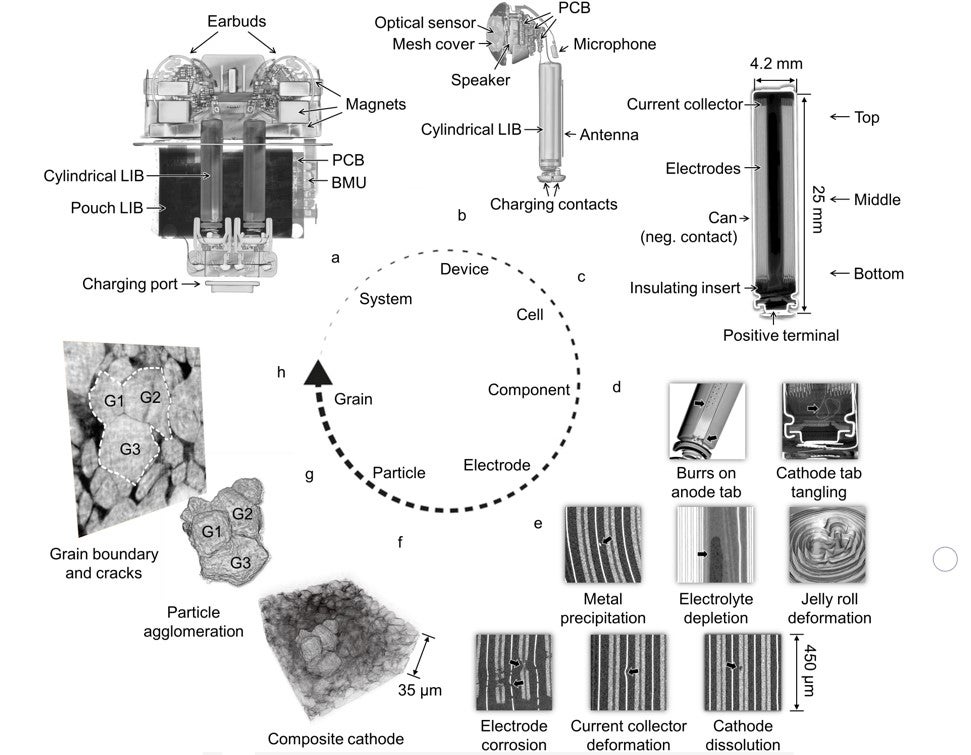
The study also highlighted the importance of considering mild and intermediate temperature effects, which are often overlooked. While extreme temperatures are known to degrade battery performance, even small fluctuations in temperature can influence the formation of solid-electrolyte interphases (SEIs), a critical component in battery stability. This insight underscores the need for more precise temperature monitoring in real-world applications, as even minor environmental changes can lead to considerable performance variations.
These findings have important implications for the future of battery design and integration. By understanding how batteries degrade in real-world conditions, manufacturers can develop more resilient designs that account for environmental influences. Optimizing device packaging, improving thermal management, and incorporating better monitoring techniques could significantly extend battery lifespan and enhance safety.
As demand for energy storage continues to grow, studies like this play a crucial role in bridging the gap between fundamental battery science and real-world applications. With continued advancements in synchrotron imaging and in-situ characterization techniques, researchers are poised to unlock even more insights into battery performance, paving the way for safer and more efficient energy solutions.
Primary Citation
G. Qian, G. Zan, J. Li, D. Meng, T. Sun, V. Thampy, A. M. Yanyachi, X. Huang, H. Yan, Y. S. Chu, S. Gul, J. Huang, S. D. Kelly, S.-J. Lee, J.-S. Lee, W. Yun, P. Cloetens, P. Pianetta, K. Zhao, O. A. Ezekoye and Y. Liu, "In-device Battery Failure Analysis", Adv. Mater. 37, e2416915 (2025) doi: 10.1002/adma.202416915