Date and Time
Location
Abstract
Catalytic interfaces transform during chemical reactions, often changing reaction rates and product distributions over time. While these changes can enhance activity and selectivity, they can also lead to loss of performance or catalyst degradation. Understanding how catalytic interfaces evolve, and ultimately predicting and controlling their evolution, is therefore key to designing stable and efficient catalytic systems.
Examples from water splitting, CO2 reduction, and nitrate reduction will illustrate the interplay between catalytic interfaces and chemical reactions. Advanced characterization under operating conditions is used to follow how catalysts and photoelectrodes change during a reaction and to understand how these changes affect activity, selectivity, and stability. These insights can then guide strategies to control the interface itself, from integrating catalysts with light-absorbing materials to modifying the local chemical environment in which reactions take place.
Looking forward, understanding the complexity of catalytic interfaces will require bringing together information from different experiments and across different spatial and temporal scales. Combining advanced characterization with theory, data science, and artificial intelligence offers new opportunities to connect these observations and understand how catalytic interfaces evolve and determine reaction outcomes. Ultimately, these approaches could enable experiments that learn as chemical systems evolve, helping us to predict and control catalytic interfaces and the reactions occurring at them.
Bio
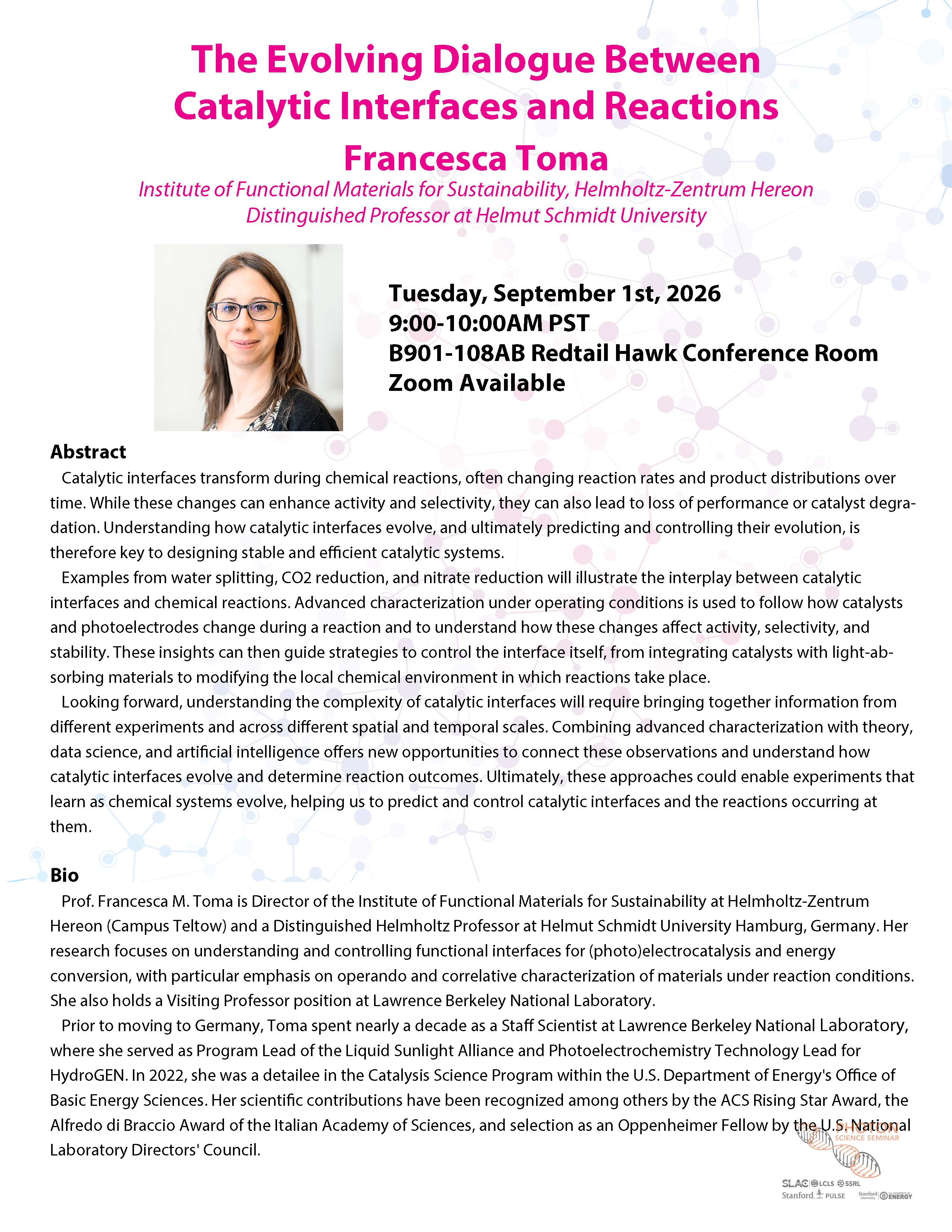
Prof. Francesca M. Toma is Director of the Institute of Functional Materials for Sustainability at Helmholtz-Zentrum Hereon (Campus Teltow) and a Distinguished Helmholtz Professor at Helmut Schmidt University Hamburg, Germany. Her research focuses on understanding and controlling functional interfaces for (photo)electrocatalysis and energy conversion, with particular emphasis on operando and correlative characterization of materials under reaction conditions. She also holds a Visiting Professor position at Lawrence Berkeley National Laboratory.
Prior to moving to Germany, Toma spent nearly a decade as a Staff Scientist at Lawrence Berkeley National Laboratory, where she served as Program Lead of the Liquid Sunlight Alliance and Photoelectrochemistry Technology Lead for HydroGEN. In 2022, she was a detailee in the Catalysis Science Program within the U.S. Department of Energy's Office of Basic Energy Sciences. Her scientific contributions have been recognized among others by the ACS Rising Star Award, the Alfredo di Braccio Award of the Italian Academy of Sciences, and selection as an Oppenheimer Fellow by the U.S. National Laboratory Directors' Council.
Links
Poster