Date and Time
Location
Abstract
Ultrafast laser pulses allow scientists to watch the wave packet motion of a molecule or material following photoexcitation with incredible time resolution. However, no ultrafast experiment can take a perfect snapshot of the molecular wave packet. Instead, spectroscopic experiments record a lossy projection of the molecular wave packet. For this reason, computer simulation has become an essential partner of ultrafast experiment. Computer simulations can provide a detailed, if approximate, picture of the motions following photoexcitation, explicitly including all nuclear and electronic degrees of freedom. Working in collaboration with ultrafast spectroscopists, our group has developed novel strategies for simulating and interpreting ultrafast spectra, with an eye toward definitively assigning spectral features to specific molecular motions. In this talk, I will present two stories of such work. First, in collaboration with the Allison group at Stony Brook University, we have developed a novel computational strategy for the direct simulation of ultrafast transient absorption spectra. We will demonstrate how this method may be used to assign spectral features to individual molecular motions in two molecules that undergo excited state proton transfer. The second story will present more recent work involving the simulation of ultrafast diffraction measurements performed at the Stanford Linear Accelerator Laboratory.
Bio
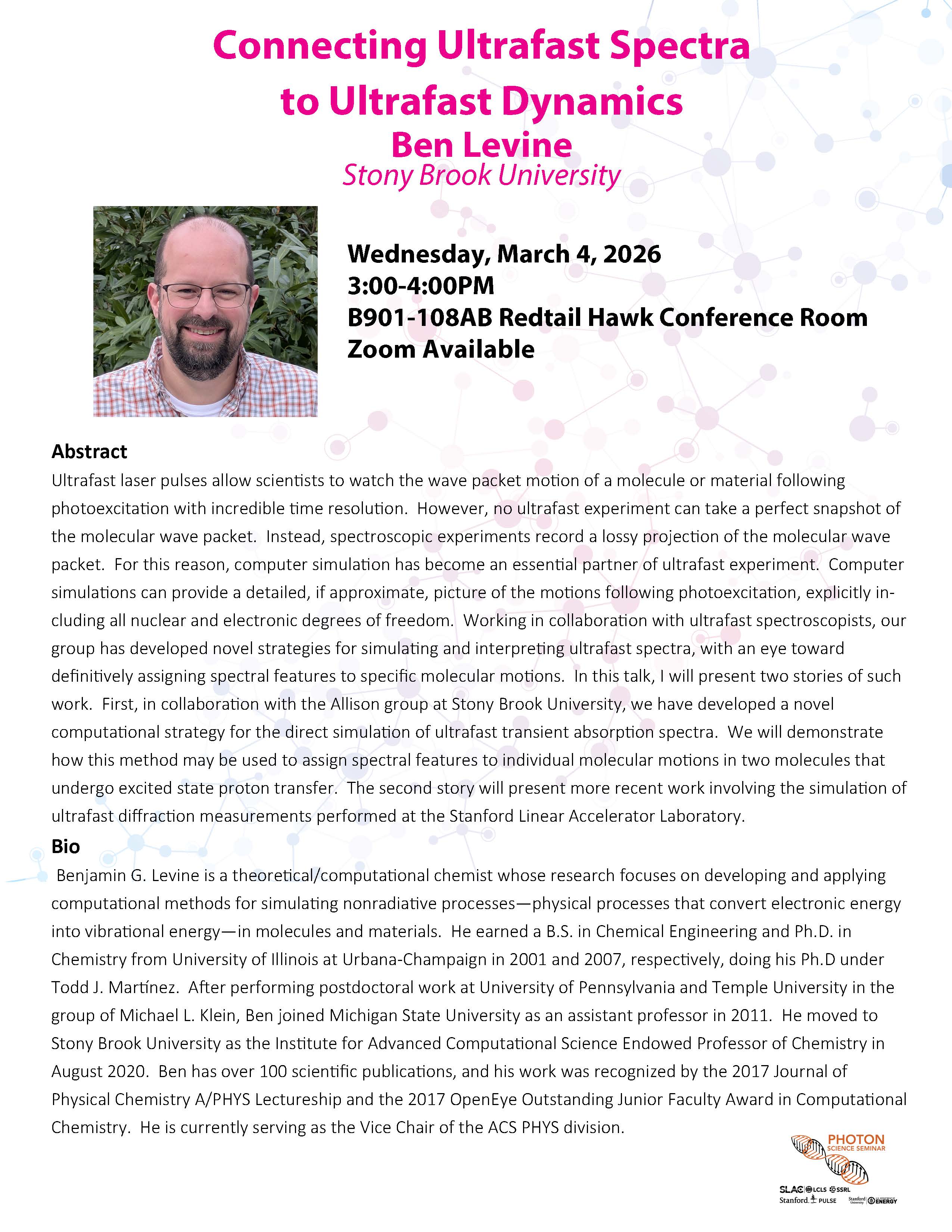
Benjamin G. Levine is a theoretical/computational chemist whose research focuses on developing and applying computational methods for simulating nonradiative processes—physical processes that convert electronic energy into vibrational energy—in molecules and materials. He earned a B.S. in Chemical Engineering and Ph.D. in Chemistry from University of Illinois at Urbana-Champaign in 2001 and 2007, respectively, doing his Ph.D under Todd J. Martínez. After performing postdoctoral work at University of Pennsylvania and Temple University in the group of Michael L. Klein, Ben joined Michigan State University as an assistant professor in 2011. He moved to Stony Brook University as the Institute for Advanced Computational Science Endowed Professor of Chemistry in August 2020. Ben has over 100 scientific publications, and his work was recognized by the 2017 Journal of Physical Chemistry A/PHYS Lectureship and the 2017 OpenEye Outstanding Junior Faculty Award in Computational Chemistry. He is currently serving as the Vice Chair of the ACS PHYS division.
Links
Poster