Date and Time
Location
Abstract
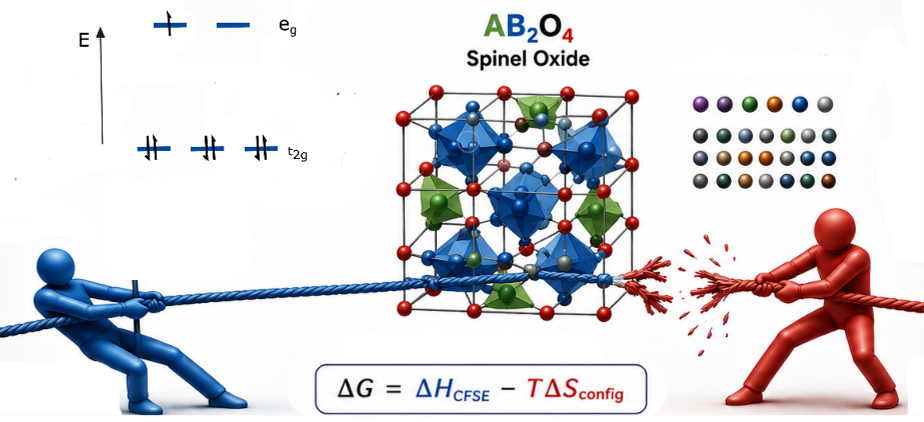
The development of multifunctional materials drives technological breakthroughs that transcend traditional device fabrication limits. While emergent physical properties are heavily explored in heterostructures and metamaterials, high-entropy oxides (HEOs) have recently garnered intense scrutiny due to their structural versatility and potential use as lithium-ion battery anodes. Within this class, high-entropy spinel oxides (HESOs) anomalously exhibit long-range magnetic ordering and enhanced electronic transport despite their supposed extreme configurational disorder. Crucially, standard literature often assumes a completely random cation distribution due to the “high” configurational entropy of the materials. However, nascent reports hint at cation site selectivity among the distinct crystallographic sublattices attributed to crystal field stabilization energy, though consensus regarding elemental occupancy and identity remains elusive. This work resolves these structural ambiguities by deploying a complementary suite of advanced synchrotron probes: high-resolution and resonant X-ray diffraction, X-ray absorption spectroscopy, and X-ray magnetic circular dichroism. By definitively mapping the local coordination environments and site-specific cation distribution, we establish a direct structural link that enables deterministic control over bulk magnetization in HESOs.
Bio
Dr. Sikhumbuzo Masina is a Research Associate at SLAC/SSRL. A PhD graduate from the University of the Witwatersrand, South Africa, he specializes in advanced synchrotron characterization. His work employs multimodal synchrotron radiation techniques like resonant X-ray diffraction, X-ray absorption spectroscopy, pair distribution function, and X-ray magnetic circular dichroism to investigate the competitive interplay of structural and magnetic order in compositionally complex spinel oxides.
Links
Poster