Date and Time
Location
Abstract
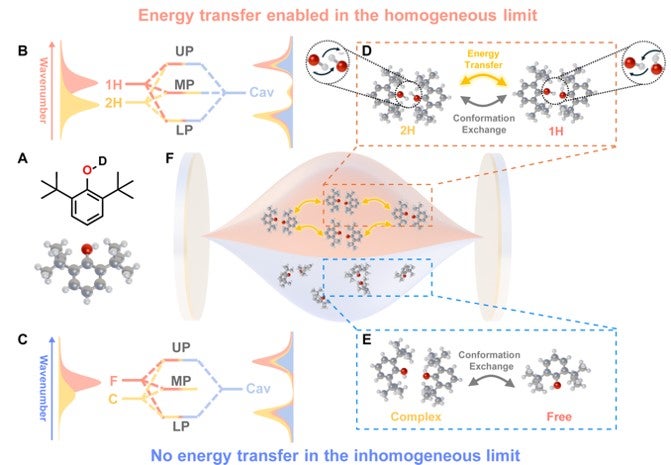
Mid-Infrared (MIR) light can interact with molecules by selectively exciting molecular vibrational modes. In combination with photonic structures, MIR can target specific vibrational states of molecular to influence chemical reactions. In this talk, I will explain how photonic environments can modify molecular dynamics through strong light-matter coupling. This strong coupling leads to the molecular vibrational polaritons – a hybrid quasiparticle between light and matter. Using two-dimensional infrared (2D IR) spectroscopy, we have demonstrated that strong coupling to photonic environments can efficiently promote energy transfer within or between molecules, subsequently slowing down competing reaction pathways. We further explored the criteria to fulfill polariton-enabled energy transfer, by which we discovered and verified a new principle to enable intermolecular energy transfer through polaritons in disorder materials. Lastly, we employed a polariton propagation experiment to determine the number of active polariton states versus the inactive dark states. This research progress provide insights into a rational mechanism and designing photonic structures to modify chemical landscapes and influence reaction pathways.
Bio
Wei Xiong is Professor and Kent Wilson Faculty Scholar in the Department of Chemistry and Biochemistry at the University of California San Diego. He received his B.S. from Peking University in 2006, earned his Ph.D. with Martin Zanni at the University of Wisconsin–Madison in 2011, and completed postdoctoral training with Margaret Murnane and Henry Kapteyn at the University of Colorado Boulder before joining UC San Diego in 2014. His research develops ultrafast nonlinear spectroscopic and imaging methods to study molecular structure and dynamics in polaritonic systems, biological materials, and energy-relevant interfaces, and he is a Fellow of the American Association for the Advancement of Science and the American Physical Society and a recipient of honors including the Alfred P. Sloan Research Fellowship, Coblentz Award, and Brown Investigator Award.
Links
Poster