Date and Time
Location
Abstract
Focusing XFEL pulses on thin Cu films results in the creation of warm dense matter with electron temperatures exceeding 100 eV. The transmitted spectrum at the Cu-L3 edge exhibits a strong intensity dependent response from increased opacity to transparency. Our theoretical framework that integrates a kinetic plasma model and a finite-temperature, short-range scattering DFT approach attributes the spectral changes to opening and closing of 2p-3d transitions in the generated ions, which also affects elastic x-ray scattering: In a recent experiment we have observed a 12-fold increase of the elastic x-ray diffraction peak at the Cu L3 edge of a B4C-Cu-SiC multilayer.
Bio
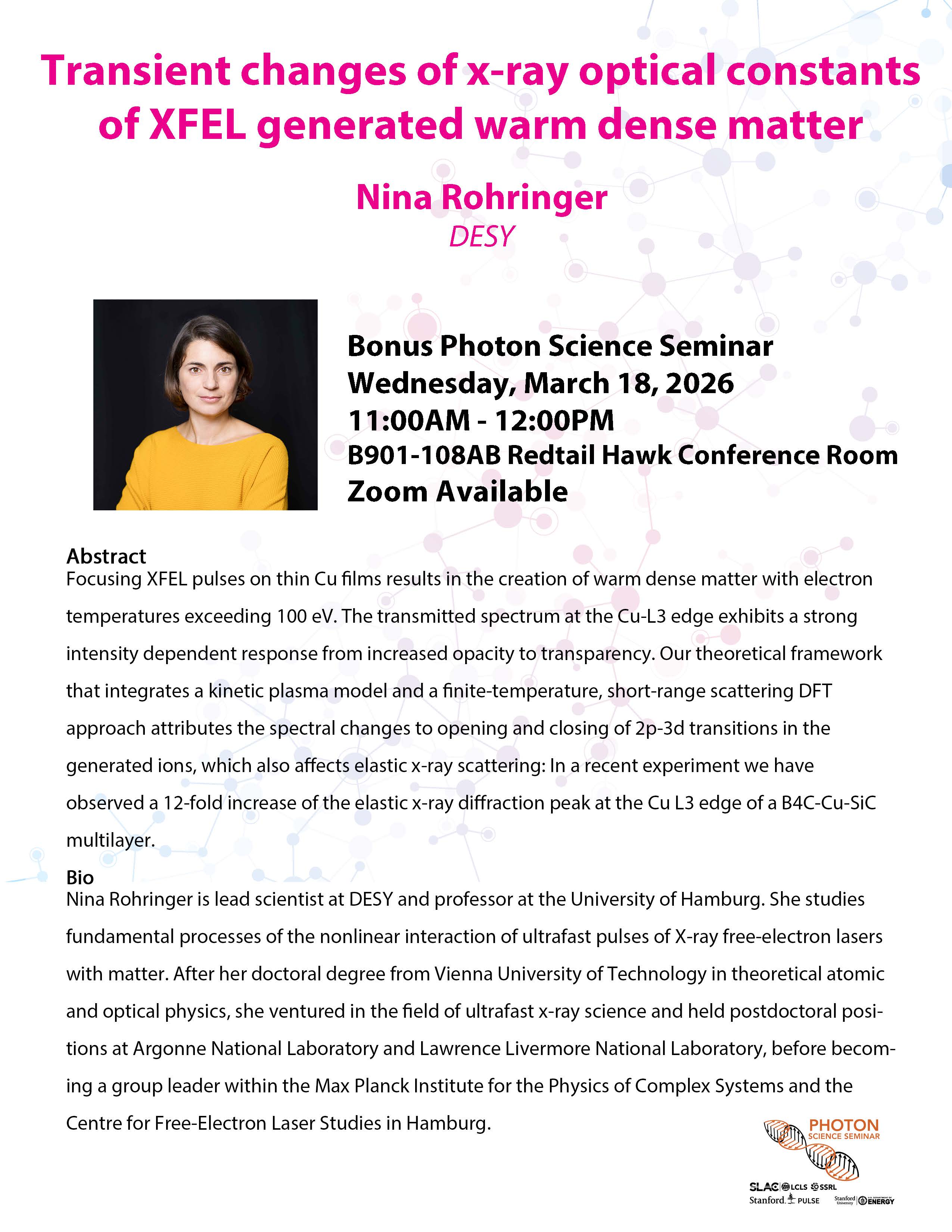
Nina Rohringer is lead scientist at DESY and professor at the University of Hamburg. She studies fundamental processes of the nonlinear interaction of ultrafast pulses of X-ray free-electron lasers with matter. After her doctoral degree from Vienna University of Technology in theoretical atomic and optical physics, she ventured in the field of ultrafast x-ray science and held postdoctoral positions at Argonne National Laboratory and Lawrence Livermore National Laboratory, before becoming a group leader within the Max Planck Institute for the Physics of Complex Systems and the Centre for Free-Electron Laser Studies in Hamburg.
Links
Poster