Date and Time
Location
Abstract
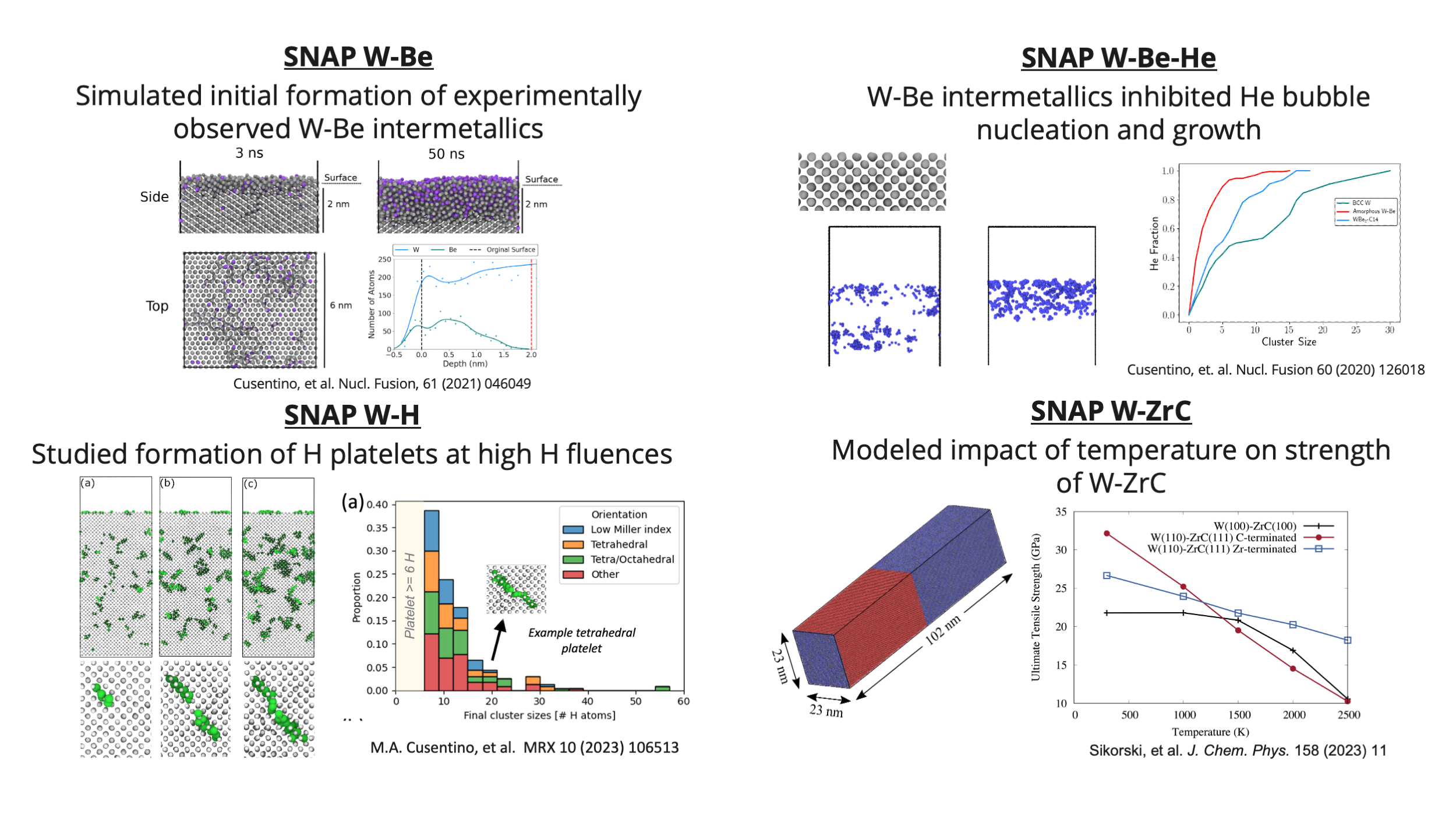
One of the biggest challenges in developing commercial fusion energy is developing materials that can handle the harsh conditions within the reactor. High thermal loads combined with intense plasma and 14 MeV neutron fluxes result in a variety of material damage phenomena including helium fuzz growth, hydrogen blistering, sputtering and redeposition, and degradation of material properties. Atomistic modeling can play a key role in understanding the fundamental processes of damage at the plasma-material interface. However, the accuracy of these simulations is tied to the interatomic potentials used, which define the force interactions that drive particle dynamics. Recently, machine learning has been used to increase the accuracy of these models. In this talk, an overview of our machine learned interatomic potential development work for modeling plasma-material interactions will be presented.
Bio
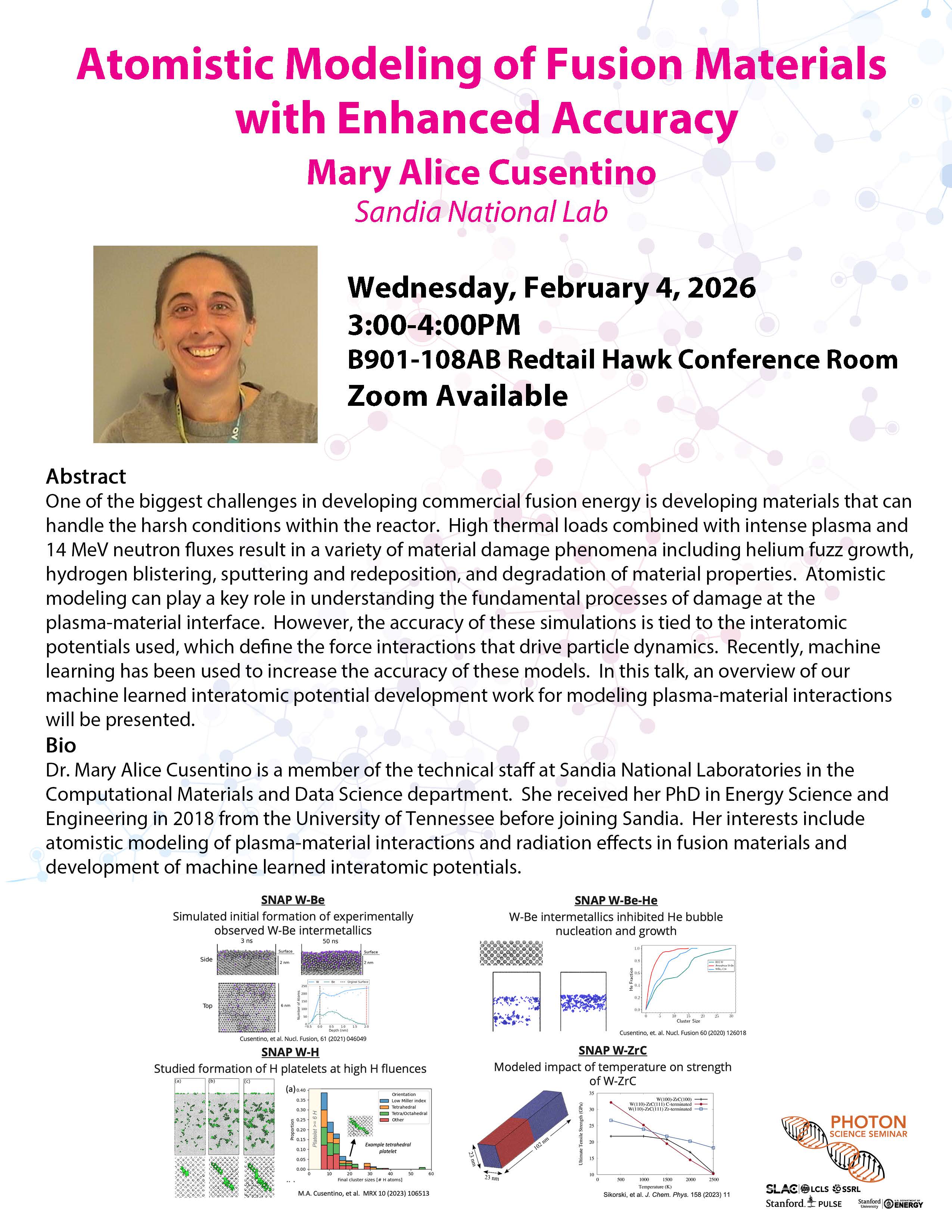
Dr. Mary Alice Cusentino is a member of the technical staff at Sandia National Laboratories in the Computational Materials and Data Science department. She received her PhD in Energy Science and Engineering in 2018 from the University of Tennessee before joining Sandia. Her interests include atomistic modeling of plasma-material interactions and radiation effects in fusion materials and development of machine learned interatomic potentials.