Date and Time
Location
Abstract
High rep rate, high flux UV to XUV generation is an important technology for semiconductor manufacturing, wafer inspection and imaging. Gas phase high harmonic systems have begun to be commercialized, while larger scale plasma fluorescence-based systems remain key infrastructure in the semiconductor industry. High Harmonic generation in solids promises scale-able and robust XUV sources of attosecond pulses. However extending the photon energy cutoff and overcoming absorption has proven challenging. We present high harmonic generation in wide band gap dielectrics with commensurate flux to HHG in Kryton gas, extending beyond 50eV and spanning over 40eV in bandwidth. Significantly we observe higher order harmonics at 50eV with similar flux to the lower orders, requiring a reassessment of current theoretical predictions and indicating that solid state is a viable route to cheaper, high average power XUV and attosecond sources.
Bio
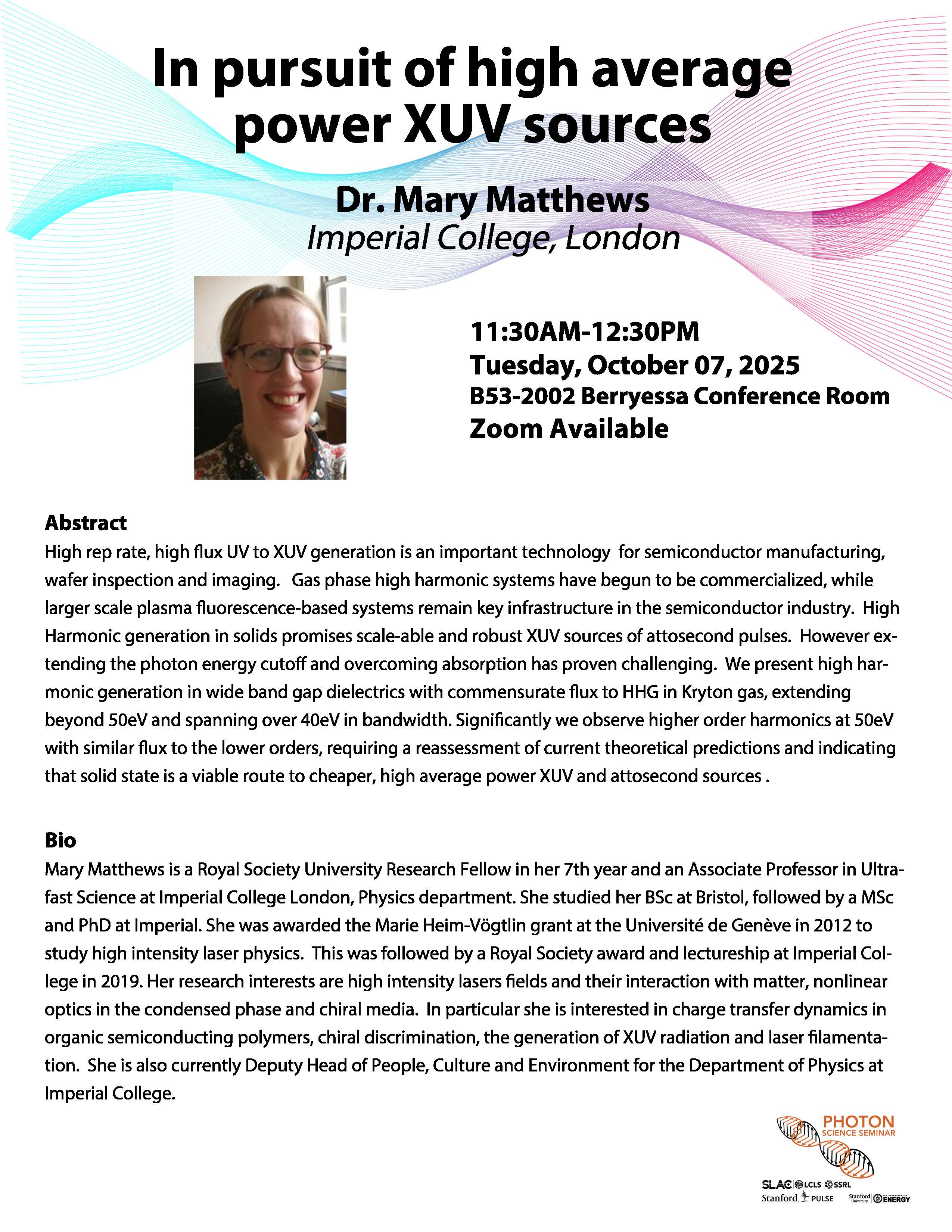
Mary Matthews is a Royal Society University Research Fellow in her 7th year and an Associate Professor in Ultrafast Science at Imperial College London, Physics department. She studied her BSc at Bristol, followed by a MSc and PhD at Imperial. She was awarded the Marie Heim-Vögtlin grant at the Université de Genève in 2012 to study high intensity laser physics. This was followed by a Royal Society award and lectureship at Imperial College in 2019. Her research interests are high intensity lasers fields and their interaction with matter, nonlinear optics in the condensed phase and chiral media. In particular she is interested in charge transfer dynamics in organic semiconducting polymers, chiral discrimination, the generation of XUV radiation and laser filamentation. She is also currently Deputy Head of People, Culture and Environment for the Department of Physics at Imperial College.
Links
Poster