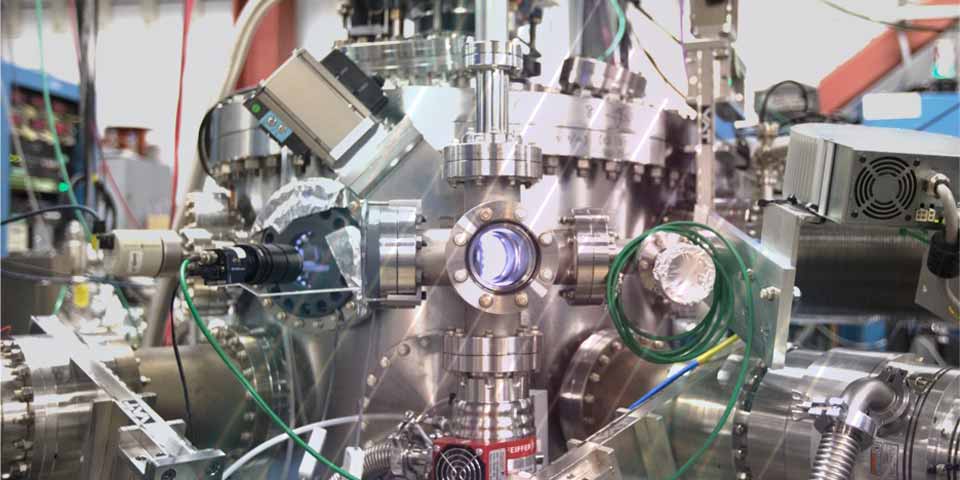
Overview
Beamline 13-3, is dedicated to advancing research in quantum materials and diverse areas of materials science through resonant soft x-ray scattering (RSXS) and spectroscopy. Equipped with a spherical grating monochromator (SGM) and an elliptical polarizing undulator (EPU), the beamline provides full polarization control, including linear (vertical and horizontal) and circular (left and right) modes. Operating within a photon energy range of 250 eV to 1800 eV, it accesses key absorption edges such as the C, O, F, and Al K-edges, 3d transition metal L-edges, and 4f rare-earth M-edges. Its versatile endstation serves as an exceptional platform for exploring the electronic, magnetic, and structural properties of advanced materials, offering researchers unparalleled precision and a suite of sophisticated tools to drive innovative discoveries.
The endstation is optimized for high-resolution RSXS measurements, particularly for reciprocal space studies. A high-precision diffractometer allows full sample and detector rotation (θ-2θ) and features broad azimuthal angles from -45° to +45°, along with flipping angles ranging from -20° to +20°. This setup enables comprehensive exploration of reciprocal space, facilitating detailed investigations into material properties.
The experimental station operates under ultra-high vacuum conditions, maintaining pressures below 10-10 Torr to prevent sample contamination. It also offers precise temperature control, ranging from approximately 10 K to room temperature (300 K), through a closed-cycle liquified helium system.
To meet a variety of experimental needs, the RSXS endstation includes two types of detectors. Schottky barrier photodiodes with a fixed pinhole slit provide high-resolution measurements, while a 2D CCD detector with vertical translation capabilities offers wide-area data acquisition, ensuring flexibility and high-quality results.
Beamline 13-3 also supports spectroscopic techniques, such as X-ray absorption spectroscopy (XAS) and X-ray magnetic circular dichroism (XMCD), utilizing the RSXS endstation. These measurements can be conducted using fluorescence yield (FY) or total electron yield (TEY) detection modes, providing flexibility for diverse experimental requirements. For XMCD studies, the beamline is equipped with a permanent magnet capable of generating magnetic fields up to 0.5 Tesla, further enhancing its versatility for investigating magnetic phenomena.
Source —
26-pole elliptical polarizing undulator (EPU), 0.25 mrad acceptance
Status —
Beamline Parameters —
| Energy Range | Resolution ΔE/E | Spot Size | Flux | |
|---|---|---|---|---|
| Focused | 250-1800 eV | ~1 x 10⁻⁴ | 0.3 (H) x 0.3 (V) mm2 | 1011 - 1012 ph/sec |
Optics —
| M0 Mirror | Monochromator | 13-3 M1 Mirror | 13-3 M2 Mirror |
|---|---|---|---|
| Horizontal flat followed by a vertical sphere, both Pt coated | Spherical Grating Monochrometer (SGM) 300 l/mm, Ni coated, below 400 eV 600 l/mm, Ni coated, between 400 eV and 800 eV 1100 l/mm, Pt coated, above 600 eV |
Horizontal focusing mirror | Vertical refocusing mirror |
Instrumentation —
| In-vacuum diffractometer | Full range of θ-2θ rotation: 0° to 180° Azimuthal: -45° ϕ 45° Flipping: -20° χ +20° Independent sample manipulation: x/y/z (±12.5 mm) Independent detector height adjustment: ±20 mm |
|---|---|
| Detectors | Point detector: GaAsP photodiode (Hamamatsu) 2D detector: in-vacuum CCD (Greateyes) |
| Optical YAG system | Beam positioning monitor: Optical Camera system Sample positioning monitor: Optical Camera system |
| Software (Operating system) | Diffractometer: SPEC (Linux) Beam Line Motor Control: EPICS (Linux) Data Analysis GUI: MATLAB (Windows) |
Sample Environment —
| Sample temperature | 10K - 300K |
|---|---|
| Sample size | ≤ 15 x 15 mm2, ≤ 5 x 5 mm2 preferable |
| Other | Load lock system (maximum: 4 samples) |
| Magnetic field: ~0.5 Tesla (through a permanent magnet) |