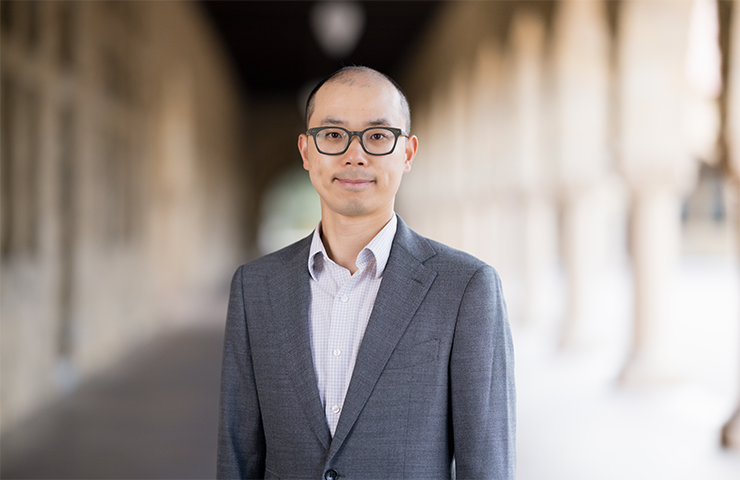
Stanford Scientist Gang Wan is honored for his multi-disciplinary research, spanning electrochemistry, catalysis, materials physics, and X-ray characterization
Interfaces are everywhere in our everyday lives. They exist where bones meet muscle in our bodies, roots meet soil in nature, or components interact within our devices, such as batteries. The behavior of these interfaces is crucial for the long-term functionality of a variety of systems. Especially in systems such as lithium-ion batteries, which power our digital and mobile lifestyles and continue to play key roles in electric vehicles and AI data centers.
X-ray and Interfacial Vision of the Battery Self-Discharge Model
Historically, lithium-ion battery research has focused on the movement of lithium ions, including self-discharge—a process by which batteries lose energy while not in use and a contributor to calendar aging.
Gang Wan, a Research Scientist at Stanford University, led the efforts to uncover an alternative battery self-discharge model. This study, combining interfacial X-ray probes with complementary techniques and electrochemical analysis, provided direct evidence that, in addition to lithium ions, protons and electrons move from solvents in battery electrolytes into layered metal oxides. Dr. Wan’s findings demonstrate that such proton-coupled electron transfer causes self-discharge and contributes to electrode degradation within the battery.
The Spicer Young Investigator Award, which Wan received this year, recognizes young investigators who have made significant contributions to the Stanford Synchrotron Radiation Lightsource (SSRL) or the broader X-ray science community. Established in 2004 in honor of William Spicer, a co-founder of SSRL, the award aims to celebrate early-career researchers' innovative work.
“Gang has the intuition to ask the right questions and has the skills to bridge science and engineering in the field of energy. He has the innate ability to go deep into a subject and can creatively connect the dots between different fields to address technical challenges,” said Arun Majumdar, Dean of the Stanford Doerr School of Sustainability.
Upon receiving the Spicer Award, Wan expressed profound gratitude for his mentors and collaborators. "This honor is deeply humbling. I am grateful for the advice and encouragement from those who have shaped my scientific vision and continue to inspire me," Wan said. He particularly acknowledged the contributions of Chia-Chin Chen from National Taiwan University; Oleg Borodin, Travis Pollard, and Marshall Schroeder from DEVCOM Army Research Laboratory; as well as beamline scientists at Argonne National Laboratory and SSRL; and theoretical teams at SUNCAT at SLAC.
Interfacing between Science Communities
"By pairing interfacial X-ray techniques with electrochemistry, Gang led efforts to uncover discoveries that have ramifications for critical applications like electric vehicles and AI data centers, where battery longevity is vital," commented Kang Xu, Chief Technology Officer at SES AI, and a Fellow of The Electrochemical Society. "Gang has the talent to seize opportunities, and he appreciates engaging in meaningful dialogue."
Wan says the Spicer Award is also very meaningful to him because of William Spicer’s seminal contributions and positive impacts on students, as well as support and advice that he received from Piero Pianetta, Paul Fuoss, Christopher Tassone, and other great people from SLAC, as well as Arun Majumdar.
"Gang demonstrated an incredible capacity to establish deep understanding of physical chemistry of catalysis and energy conversion systems and develop integrated, interfacial X-ray characterization approaches to validate his hypotheses about what was driving performance" said Christopher Tassone, the Associate Laboratory Director of the Energy Science Directorate at SLAC National Accelerator Laboratory.
In addition to electrochemical phenomena, Gang Wan also made contributions to interfacial phenomena in relevance to chemical transformation and materials physics using synchrotron X-ray.
His research on methane removal has provided scientific insights with innovative engineering solutions, overcoming long-standing challenges in the activity-stability trade-off in thermal catalysis. These findings hold promises for reducing methane emissions from natural gas systems, further supporting sustainable energy practices. Wan co-led another study of phase transition, which discovered intermittent behaviors of oxygen vacancies in oxide heterostructures employing coherent synchrotron X-ray.
Looking ahead, Wan's research aims to continually transform understandings of interfacial and electrochemical phenomena, which could be pivotal for developing the next generation of energy conversion, as well as physical and chemical transformation essential to energy-efficient technologies.
For more information on Gang Wan's research, please refer to papers outlining his findings, including his notable publications in Science, ACS, Nature Catalysis, and Advanced Materials.
The Stanford Synchrotron Radiation Lightsource is a U.S. Department of Energy (DOE) Basic Energy Science User Facility located at DOE’S SLAC National Accelerator Laboratory, which is operated by Stanford University.