|
|
Impact of Recent Research on Environmental
Remediation and Technologies John R. Bargar and Gordon E. Brown, Jr. Molecular Environmental Science Group Stanford Synchrotron Radiation Laboratory Table of Contents
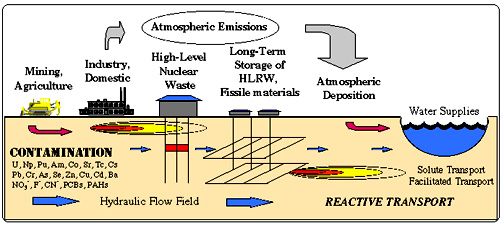
I. Introduction Anthropogenic contaminants such as heavy
metals and radionuclides enter the biosphere through a number of human
activities, including mining, industrial and domestic activities, nuclear
weapons production, and the burning of fossil fuels (Figure 1). In addition
to these sources, leakage of HLW and fissile materials stored in repositories
could lead to serious contamination problems. Contaminants are commonly
transported and dispersed in the subsurface by groundwater in response
to the hydraulic gradient, resulting in contaminant plumes such as shown
in Figure 1. Contaminant species may react strongly with soil and aquifer
particles, resulting in retarded or facilitated dispersion, or they may
react only weakly or not at all. In addition, they may react with dissolved
complexing agents, become incorporated in relatively insoluble precipitate
phases, be transformed abiotically into relatively benign forms, used
as energy sources by microorganisms, or be taken up and sequestered by
plants, all of which affect the ultimate fate of contaminant species.
The development of strategies and cost-effective technologies for removing chemical contaminants from soils, sediments, natural waters, and immobilizing them in man-made waste forms requires knowledge of their speciation (element identity, physical state, oxidation state, chemical formula, and molecular structure), reactivities, and chemical transformations under the relevant chemical conditions. For example, chromium, a common carcinogenic contaminant, reacts weakly with soils and aquifer materials when present as Cr(VI). Thus, Cr(VI) is often transported great distances in natural environments, and costly remediation efforts are required to remove it. When reduced to Cr(III), however, it is much less toxic and adsorbs strongly to natural materials and/or precipitates as relatively insoluble oxyhydroxide phases. As a result, Cr(III) is relatively immobile in aquifers and surface waters and poses less risk to wildlife and humans. Uranium behaves in a similar fashion; U(VI) is mobile in groundwaters and can be transported many kilometers, whereas U(IV) is highly insoluble and thus immobile in groundwaters. However, insoluble Cr(III) and U(IV) precipitates are very difficult to remove from contaminated soils by conventional soil-washing procedures. Clearly, knowledge of the molecular-scale speciation of environmental contaminants and the complex chemical processes that govern their transformations, uptake, and release are necessary for assessing contaminant-related risk and developing cost-efficient remediation technologies. A new multidisciplinary field concerned with these issues, molecular environmental science (MES), has recently emerged in response to these needs. Synchrotron-based spectroscopic techniques, such as XAFS (x-ray absorption fine structure) spectroscopy, have proven to be among the most useful tools for characterizing the speciation of metal ions, metal-inorganic anion complexes, and metal-organic complexes in natural samples, the chemical processes that govern their transformations, and their reaction rates. Synchrotron x-ray sources provide tunable, high intensity (e.g., 1011 photons/sec) x-rays over a broad energy range (> 103 eV), making possible element-specfic measurements at the low concentrations (1000 ppm to ppb ranges) that are typical of environmental samples. Such high-intensity x-rays cannot be produced using conventional sealed-tube or rotating anode x-ray generators. In addition, fluorescence-yield detection enables the collection of XAFS spectra in-situ from water-bearing samples at environmentally relevant temperatures and pressures. Wet samples are critical to environmental studies since water is ubiquitous in the environment and natural samples are often modified by drying and crushing procedures and vacuum conditions. XAFS spectroscopy provides qualitative and quantitative information about the oxidation states, coordination environments, and short-range order of metal ions, including metal-oxygen bond distances and coordination numbers. No other structure characterization techniques provide such element-specific information for metal ions in micro-, poorly crystalline or amorphous solids, liquids, and gases. Thus, XAFS spectroscopy has begun to play a very important role in MES research. The success of XAFS spectroscopy as a tool for characterizing metal-ion speciation in complex natural samples has led to a large increase in demand for synchrotron beamtime, as scientists from a wide range of environmental disciplines such as environmental chemistry/geochemistry, environmental microbiology, plant biology, and soil science, begin to utilize this tool. For example, at SSRL, the number of eight-hour shifts awarded for MES research has increased from 402 shifts in 1993 to 1,075 shifts in 1996. Currently, all SSRL beamlines are oversubscribed. XAFS studies are increasingly being coupled with other synchrotron-based techniques such as micro-XAFS spectroscopy, soft x-ray spectromicroscopy, x-ray standing wave studies, and x-ray scattering methods, which provide complementary information about the speciation and spatial distribution of metal ions in samples. In response to this growth and the need
for staff support of MES users, SSRL hired a MES scientific staff member
(John Bargar) in late 1996 and is constructing a high-flux beamline (BL
11-2) dedicated to MES research (funded by DOE-BES-Chemical Sciences).
This beamline will provide approximately 3 to 10 times more flux than
SSRL beamlines commonly used for MES research over the energy range 5
- 23 keV, which includes the K-absorption edges of transition metals and
the L-edges of heavy metals and actinides. In addition, the beamline
will feature an experimental hutch designed for XAFS measurements of toxic
and/or radioactive samples, and will be outfitted with a high throughput,
30-element Ge detector for use on compositionally heterogeneous and dilute
natural samples. Thus, it will be possible to study samples at least
50 times more dilute than currently possible with SSRL beamlines commonly
used for MES research. For example, it will be possible to study metal
ion adsorption at defect sites (which are typically present at low surface
concentrations) on single crystal surfaces. Such model system studies
are essential for defining the chemical processes that determine the behavior
of contaminant species. The amounts of radioactive materials required
for analysis will be smaller, resulting in increased safety. Furthermore,
the higher flux will facilitate micro-XAFS measurements at 10 mm
length scales, making it possible to determine the spatial distribution
of contaminant species in heterogeneous samples. The first x-ray absorption spectrum was
observed by de Broglie in 1913 who noticed two sharp and intense features
on a photographic film used in a rotating crystal spectrograph. These
features proved to be absorption lines of Ag and Br contained in the photographic
emulsion on the film. Because of the high energies of these absorption
lines (25.51 and 13.47 keV, respectively), these spectra were of low resolution
and no fine structure was observed. During this same time period, C.G.
Barkla began to systematically examine the phenomena of x-ray absorption
and emission. He discovered that elements absorb most strongly at discrete
x-ray energies, referred to as absorption edges, and that these discrete
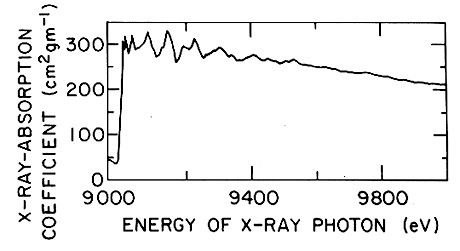
absorption energies are characteristic of the element. The Cu K-absorption
edges shown in Figure 2 illustrate the sharp rise in x-ray absorbance
when the x-ray energy matches the binding energy of the 1s electron of
Cu.
In 1920, Kossel proposed the correct theoretical explanation for absorption edge maxima when he concluded that the energies of successive absorption maxima of an element correspond to the photon energies required to promote the 1s, 2s, 2p1/2, 2p3/2, 3s, etc. electrons of the absorbing element to the first empty energy states. These maxima were labeled the K, LI, LII, LIII, MI, etc. absorption edges, corresponding to designations of the atomic energy level from which the electron is excited. The structure at the absorption edge due to electronic transitions involving individual atoms has since been called the Kossel structure. At photon energies just above an absorption edge, the probability of photon-electron interactions is high, and it drops off in a smooth fashion with increasing photon energy. This effect is shown in Figure 3, which illustrates the absorption of a Cu metal foil with increasing photon energy. Fine structure associated with K absorption
edges of the elements Mg, Fe, and Cr in condensed matter was first observed
by H. Fricke in 1920. During the next ten years, others examined the
K and L absorption edges of additional elements in various phases including
gases and aqueous solutions. Simultaneously, Kronig began developing
a theory based on Bragg scattering of the ejected photoelectrons to explain
the extended fine structure, which bears his name (Kronig structure).
Considerable effort was spent in developing both long-range and short-range
scattering theories for XAFS in the forty years following Kronig's theoretical
work. In the mid-1960's, Lytle and Levy first used short-range scattering
theories to derive accurate bond distances from EXAFS (extended
XAFS, which is the name given to the XAFS region starting about 30 eV
above the absorption edge and extending up to 1000 eV above the edge).
However, the real breakthrough in developing the modern methods of EXAFS
analysis occurred in 1971 when Dale Sayers and Edward Stern of the University
of Washington and Farrell Lytle of the Boeing Corporation in Seattle,
Washington, recognized that Fourier transformation of EXAFS data, with
respect to the photoelectron wave vector k, gives peaks at distances
corresponding approximately to the distances to nearest neighbors around
an absorber. Fourier transform-derived distances differ from the exact
absorber-backscatter distances due to phase-shift effects caused by the
interaction of the scattered photoelectron with the electric fields of
the absorbing and scattering atoms. However, accurate absorber-backscatterer
distances can be obtained when the EXAFS data are corrected for these
phase-shift effects. Sayers and Lytle performed the first synchrotron-based
EXAFS experiment at SSRL in 1974. This experiment, coupled with the availability
of synchrotron light sources to general users, started the modern era
of XAFS spectroscopy. Use of this method in many diverse scientific disciplines
has grown over the past 25 years, and XAFS methods (including XANES -
x-ray absorption near edge structure - spectroscopy) are now well
established. The experimental methods of XAFS spectroscopy have improved
substantially since the first synchrotron-based experiments. Over the
past decade there have been substantial improvements in the stability
and availability of high-flux, high-brightness synchrotron sources, as
well as in beam lines optics, and x-ray detectors (brightness is a measure
of the vertical and horizontal dimensions, divergence, and flux of a synchrotron
x-ray beam). These advances have extended the usefulness of XAFS in MES
research by allowing detection and characterizations of increasingly lower
concentrations of contaminant species. High-brightness third-generation
synchrotron light sources have provided the capability to determine the
spatial distributions of chemical species for a given contaminant element.
Furthermore, first-principles ab-initio multiple-scattering methods
have been developed and are available to users through computer codes
such as FEFF (Rehr and Albers, 1990; Rehr et al., 1991; Rehr et
al., 1992) which can accurately calculate the EXAFS spectrum of an
element in any structural environment. These theoretical advances have
moved EXAFS spectroscopy from a semi-quantitative structural method to
a fully quantitative one that rivals x-ray scattering for structural studies
of elements in certain classes of materials (e.g., amorphous materials
and liquids) and surpasses most other structural methods for experimental
studies of elements at environmental interfaces. Efforts are currently
underway to extend the usefulness of theoretical codes to XANES regions
of XAFS spectra, which are dominated by multiple-scattering processes.
With this next advance in theory, XANES spectroscopy should move from
a semi-quantitative to a quantitative method, which will have a significant
impact on MES research due to the considerably higher amplitude of the
adsorption edge of an element relative to its EXAFS. This development
will permit characterization of contaminant speciation at even lower concentrations
than is now possible with EXAFS spectroscopy alone. The ability to probe the speciation, spatial
distribution, and reactivity of metal ion contaminants in natural samples
at SSRL has been utilized by a growing number of scientists to investigate
the reaction of metal ions including arsenic, cadmium, chromium, lead,
selenium, and uranium with environmentally important oxides and plants.
Highlights from some of these investigations are described in the sections
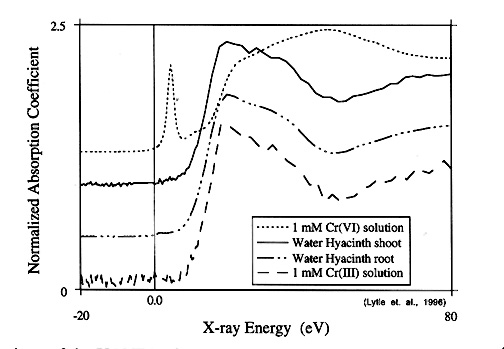
that follow. In order to understand the fundamental controls on Cr(VI) reduction by iron, the reaction of Cr(VI) with Fe(II,III)-oxides, which are expected to thinly encrust iron particles exposed to groundwater, was studied in a collaborative research effort at SSRL (Peterson et al., 1996; Peterson et al., 1997a; Peterson et al., 1997b) by Maria Peterson and Gordon Brown of the Department of Geological & Environmental Sciences, Stanford University, in collaboration with Art White of the US Geological Survey (Menlo Park, CA) and Carol Stein of the University of Washington (Seattle). XAFS spectroscopy was used to characterize the oxidation state and local structure of chromium reacted in simplified synthetic models and in chromium-contaminated soil samples from Sandia National Laboratory and from the U.S. Naval Research Weapons Lab in Keyport, Washington. Samples were also characterized by high-resolution transmission electron microscopy and batch kinetic studies. The results of these studies indicate that
that natural Fe2+-containing iron oxide phases such as magnetite
(Fe3O4) do reduce Cr(VI) to Cr(III), as indicated
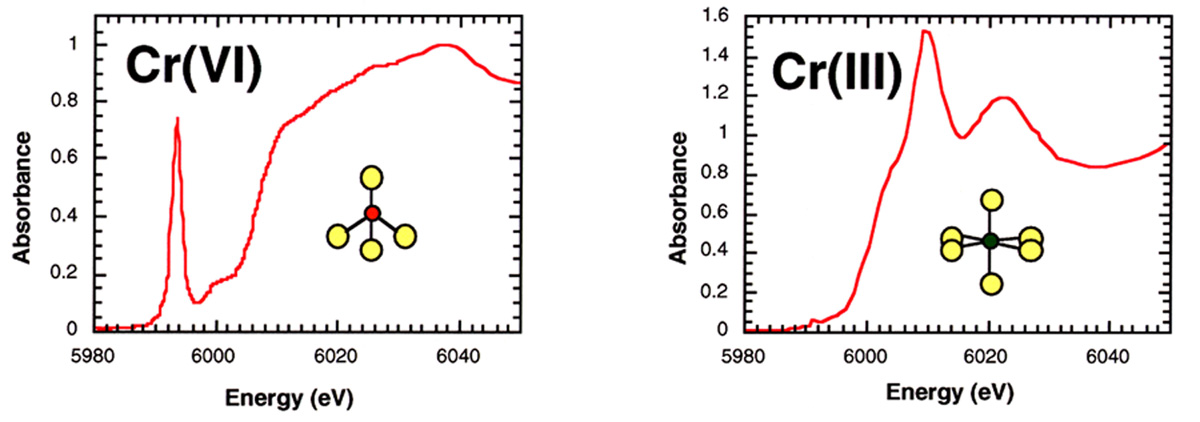
by x-ray absorption near-edge structure (XANES) spectroscopy. The usefulness
and sensitivity of Cr K-edge XANES structure to chromium oxidation state
and local coordination geometry are illustrated in Figure 3, which shows
a comparison of Cr(VI) and Cr(III) XANES spectra. The characteristic
features in these spectra can be used to quantify the ratio of Cr(III):Cr(VI)
in dilute samples. XAFS is the only technique capable of providing such
definitive oxidation state information from dilute samples under environmentally
relevant conditions, and these experiments could not have been done without
using a synchrotron light source. An electron-transfer reaction at the
magnetite-aqueous solution interface is implicated by these findings,
which induces a transformation of Fe3O4 surfaces
to g-Fe2O3.
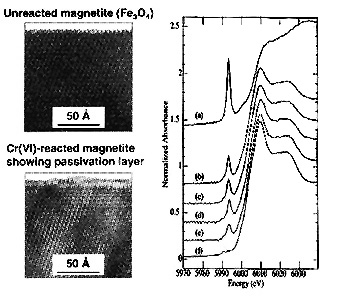
This reaction halts when the thickness of the g>-Fe2O3
layer reaches about 15 Å on the magnetite surface. Figure 4 is
a TEM image of the Cr(III)-bearing g-Fe2O3
passivating layers that form on the surfaces of magnetite particles.
Such passivation reactions are also expected to occur in zero-valent iron
PRBs and could lead to their failure after relatively short time periods.
Zero-valent iron PRBs have also been proposed for reductive remediation
of radioactive Tc(VII) and U(VI) in groundwater at US DOE sites, and reductive
dechlorination of halogenated hydrocarbons such as trichloroethylene (TCE),
which is a widespread organic contaminant in the U.S. Studies of these
reduction reactions on iron oxides are currently underway as part of a
Stanford University-PNNL collaboration funded by the Environmental Management
Science Program. Since oxidative passivation of the iron particle surfaces
could occur in all of these systems, the results of Peterson et al. indicate
that design and selection of materials for PRBs must account for these
reactions in order to achieve cost-effective, long-term remediation.
These findings are also relevant to technological products, such as film
substrates and nanoparticle ultracapacitors, in which the surface properties
of Fe(II,III) oxides are engineered and utilized.
XAFS Studies of Radionuclides An increasingly important application of XAFS spectroscopy at SSRL is the study of the chemical forms and transformations of radionuclides in contaminated soils and temporary radioactive waste storage facilities at DOE sites, such as the Fernald, OH uranium processing plant, and the Hanford Tank Farm in Hanford, WA. For example, scientists from Los Alamos National Laboratory, (Steve Conradson, David Clark, David Morris, Drew Tait, and others) and Pacific Northwest National Laboratory (Nancy Hess) have found that about 20% of the uranium in Fernald soils cannot be removed by washing with carbonate solution, a technique commonly used to chelate and solubilize uranium adsorbed on soil particles. XAFS measurements revealed the presence of an insoluble U(VI)-phosphate phase as well as an insoluble U(IV)-containing phase (Morris et al., 1996). This work prompted a change in remediation methods that will result in major cost savings. The first XAFS studies of Hanford Tank samples conducted by this same group of scientists at SSRL showed that 90Sr is present as different chemical species in the same tank as well as in different tanks. A knowledge of the speciation of radioactive elements like 90Sr
In a related study, Steve Conradson and
others have used XAFS spectroscopy and x-ray scattering methods to examine
the effects of aging on Pu alloys that comprise the pits of nuclear weapons,
a major effort in the science-based stockpile stewardship program. These
studies have shown that significant changes in the density of these samples
with time is related to major changes in the local coordination environment
around Pu in these alloys caused by radiation damage.
The mechanism of cadmium uptake and accumulation in indian mustard (Brassica juncea L) are being investigated in another set of XAFS studies at SSRL conducted by Ingrid Pickering (SSRL), David Salt (Rutgers University, Center for Agricultural and Molecular Biology), Roger Prince and Ilya Raskin (Exxon Research and Engineering) (Salt et al., 1995). Cadmium K-edge XAFS spectra of plants grown in cadmium-containing solutions indicate that cadmium in the root tissues of these plants is complexed by sulfur ligands, most likely as CdS4 complexes. In contrast, in the xylem sap, which transports the cadmium to the leaves where it is bound, cadmium is complexed by nitrogen and/or oxygen ligands. This study is the first step in identifying the chelating agents that are responsible for cadmium transport within this species. Knowledge of these chemical agents is necessary in order to select and genetically engineer crops with greater capacities for accumulating cadmium and other common contaminants with similar coordination chemistries, such as nickel, copper, and zinc. Speciation of Lead and Arsenic in Mine Wastes and Sediments: Implications for Risk Assessment and Remediation Strategies. Mining operations often lead to the contamination of soils, surface waters, and aquifers by heavy metals, which are concentrated in mine drainage effluent and/or are leached out of mine tailings by rainwater. Due to the toxicity and abundance of heavy metal contamination in such locations, many mining areas have been designated as US Superfund sites, e.g., the Leadville, CO mining district. Assessment of the risk posed to potable water due to migration of heavy metal contaminants in groundwater in such areas and remediation of the affected soils and groundwaters are critical needs. Accurate assessment and subsequent remediation requires knowledge of the speciation of metal ions (i.e., their oxidation states, molecular structure, distribution among dissolved, adsorbed, and solid phases, and the presence and effects of complexing ligands). The speciation of heavy metals is strongly affected by other dissolved constituents, such as carbonate (CO32-), alkali and alkaline earth cations, and co-contaminants such as sulfate (SO42-), arsenate (AsO43-), and other metal ions, which are important groundwater solutes in many areas disturbed by mining. For example, the complexation of lead cations by aqueous carbonate species could lead to an enhancement of lead transport in groundwater. It is also possible that metal ions such as arsenate could coprecipitate with aqueous Al(III) and Fe(III) to form phases that are relatively insoluble and act as sinks for As contamination. Similarly, Pb can complex with phosphate in soils to form an insoluble Pb-phosphate precipitate known as pyromorphite, the Pb analog of apatite. Stanford scientists, including the two authors and graduate students in the Department of Geological & Environmental Sciences, have used XAFS spectroscopy in conjunction with complementary non-synchrotron techniques to study the speciation of arsenic and lead in contaminated sediments from mine wastes at Trona, Jackson, and Marysville, CA (arsenic) (Foster et al., 1997) and Leadville, CO (lead) (Ostergren et al., 1996). Collaborative research at SSRL on related samples from various localities in France and California has recently been initiated with Prof. Georges Calas and other French collaborators (U. Paris), Prof. Janet Hering (Cal Tech) and her students, and Dr. James Rytuba (U.S. Geological Survey). Natural samples are often compositionally heterogeneous, containing heavy metals in a number of different species. To interpret the spectra from these complex samples, they were compared to spectra from model compounds and simplified synthetic model systems in which the speciation of arsenic and lead are known. This work has resulted in several key findings described below that have significant implications for remediation strategies. Arsenic most commonly occurs in the oxidation states (0), (III), and (V) in natural samples. As(III) is the most toxic form to humans and is more readily transported in groundwater than the (0) and (V) oxidation states. Selective chemical extractions, which have traditionally been used to determine the oxidation states of “surface-bound” arsenic, cannot distinguish between arsenic in relatively insoluble precipitates, mineral grain coatings, fine-grained particles, and adsorbed arsenic. With renewed interest by the U.S. Environmental Protection Agency in lowering the maximum As levels in drinking water, it is important to obtain more accurate information on the speciation of As in contaminated soils and mine tailings than is possible with selective extractions. XAFS spectroscopy is well suited to this problem, since it can provide information on the oxidation state and local coordination environments of arsenic in dilute natural samples. In the case of arsenic-contaminated mine samples, XANES analyses showed that the dominant forms of arsenic are As(V) and As(0) (Foster et al., 1997). The more toxic and mobile As(III) species was not detected in this work. Moreover, As(V) was found in both crystalline arsenate phases and as chemisorbed species on mineral surfaces. The stability of these crystalline species and the amount of chemisorption may fluctuate substantially on diurnal and annual time scales, due to fluctuations in the pH and composition of groundwater. Risk assessment models for arsenic contamination in these environments must account for these species in order to accurately predict arsenic transport and toxicity. Furthermore, effective remediation strategies must be capable of removing or neutralizing As(0) and As(V) in solid phases, and surface-bound arsenic. In another set of investigations, mine
tailings in Leadville, CO were examined to characterize surface Pb species
(Ostergren et al., 1996). Previous work by the authors and graduate
student John Ostergren in the Department of Geological & Environmental
Sciences, including electron probe micro-analysis (EPMA), x-ray photoelectron
spectroscopy (XPS), and “selective” chemical extractions, have indicated
that surface species may account for up to 50% of the total lead in these
tailings samples. Our EXAFS results confirm that both of the Leadville
tailings contain significant amounts of lead adsorbed to oxide surfaces.
However, the EXAFS results also indicate that MgCl2 sequential
extractions, which are commonly assumed to be effective at removing weak
surface-bound lead species, resulted in a redistribution of lead species.
These results indicate that use of MgCl2 extractions to quantify
adsorbed lead in for predictive risk assessment models could lead to substantial
error. One of the keys to understanding and potentially
solving this problem is knowledge of the speciation, or chemical forms,
of selenium in affected soils and groundwaters and the chemical processes
that cause selenium(VI) to transform into more benign species. XAFS studies
of selenium speciation in soils from the Kesterson Reservoir region have
been performed by SSRL scientists, including Ingrid Pickering and Gordon
Brown, Jr. in collaboration with Tetsu Tokunaga, a soil scientist at Lawrence
Berkeley National Laboratory (Pickering et al., 1995; Tokunaga
et al., 1996). This work has shown that selenium in the Kesterson
soils occurs in the elemental form, which is insoluble and immobile.
Furthermore, the elemental state was shown to be stabilized against reoxidation
under oxic conditions, such as occur during droughts, by organic matter.
These results indicate that any solution to this problem must account
for the presence of both oxidized and reduced forms of selenium in the
soils. The natural occurrence of elemental selenium in Kesterson soils
suggests that remediation strategies based on reduction of oxidized selenium
species to Se(0), such as microbial treatment of agricultural drainage
waters, could be successful solutions to this problem.
Many studies have suggested that the primary
pathway for selenium reduction in contaminated soils involves microbial
activity. However, a recent XAFS study by Satish Myneni, Tetsu Tokunaga
(LBNL) and Gordon Brown (Stanford University) conducted at SSRL has shown
that rapid reduction of Se(VI) can be achieved abiotically when Se(VI)
in solution reacts with "green rust" (Fe(II)4Fe(III)2(OH)12SO4
• 3H2O), a common Fe(II)-containing phase in the near surface
environment (Myneni et al., 1997). This discovery provides a heretofore
unknown alternative pathway for the reduction of selenium and other redox-sensitive
oxoanions such as As(V)O43- and Cr(VI)O42-).
Foster A. L., Brown G. E., Jr., Tingle T. N., and
Parks G. A. (1998) Quantitative arsenic speciation in mine tailings using
x-ray absorption spectroscopy. Am. Mineral. 83, 553.
Lytle, C.M.,Lytle, F.W., Yang, N., Qian, J.H.,
and Terry, N. (1997) Phyto-conversion of Cr6+ to Cr3+
by water hyacinths (Iechhornia crassipes Solmsp.). Science
(in submission).
Morris D.E., Allen P.G., Berg J.M., Chisholm-Brause
C.J., Conradson S.D., Donohoe R.J., Hess N.J., Musgrave J.A., and Tait
C.D. (1996) Speciation of uranium in Fernald soils by molecular spectroscopic
methods: Characterization of untreated soils. Environmental Science
and Technology 30, 2322-2331.
Myneni, S.C.B., Tokunaga T.K., Brown, G.E., Jr.
(1997) Abiotic selenium redox transformations in the presence of Fe(II,III)
oxides. Science 278, 1106-1109.
Ostergren J.D., Tingle T.N., Brown G.E., Jr., and
Parks G.A. (1996) Lead speciation in selected mine wastes from Leadville,
CO: chemical extraction, EPMA, XPS, and XAFS investigations. Abstracts
with Programs, Geological Society of America, Annual Meeting, A-519.
Peterson M., Brown G. E., Jr., and Parks G. A.
(1996) Direct XAFS evidence for heterogeneous redox reactions at the aqueous
chromium/magnetite interface. Colloids and Surfaces A 107,
77 - 88.
Peterson M. L., Brown G. E., Jr., and Parks G.
A. (1997a) Quantitative determination of chromium valence in environmental
samples using XAFS spectroscopy. In Aqueous Chemistry and Geochemistry
of Oxides, Oxyhydroxides, and Related Materials (ed. J.A. Voigt, T.E.
Wood,, B.C. Bunker, W.H. Casey, L.J. Crossey), pp. 75-80, Materials Research
Society.
Peterson M. L., Brown G. E., Jr., Parks G. A.,
and Stein C. L. (1997b) Differential redox and sorption of Cr(III/VI)
on natural silicate and oxide minerals: EXAFS and XANES results. Geochim
Cosmochim Acta 61, 3399-3412.
Peterson M. L., White, A.F., Brown G. E., Jr.,
Parks G. A. (1997c) Surface passivation of magnetite (Fe3O4)
by reaction with aqueous Cr(VI): XAFS and TEM results. Environ. Sci.
Technol. 31, 1573-1576.
Pickering I. J., G.E. Brown J., and Tokunaga T.
K. (1995) Quantitative speciation of selenium in soils using s-ray absorption
spectroscopy. Environ. Sci. Technol. 29, 2456-2459.
Rehr J. J. and Albers R. C. (1990) Scattering-matrix
formulation of curved-wave multiple-scattering calculations of x-ray absorption
fine structure. Phys. Rev. B 41, 8139-8149.
Rehr J. J., Mustre de Leon J., Zabinsky S. I.,
and Albers R. C. (1991) Theoretical x-ray absorption fine structure standards.
J. Amer. Chem. Soc. 113, 5135-5140.
Rehr J. J., Zabinsky S. I., and Albers R. C. (1992)
High-order multiple-scattering calculations of x-ray absorption fine structure.
Phys. Rev. Lett. 69, 3397.
Salt D. E., Prince R. C., Pickering I. J., and
Raskin I. (1995) Mechanisms of cadmium mobility and accumulation in indian
mustard. Plant Physiology 109, 1427-1433.
Shoemaker S. H., Greiner J. F., and Gillham R.
W. (1995) Permeable Reactive Barriers. In Assessment of Barrier Containment
Technologies (ed. R. R. Rumer and J. K. Mitchell), pp. 301-353. National
Technical Information Service.
Stern, E.A., and Heald, S. M. (1983) Basic principles
and applications of EXAFS. In Handbook on Synchrotron Radiation (ed.,
E. Koch), pp. 955 - 1014. North Holland Publishing, Amsterdam.
Tokunaga T., Pickering I. J., and Brown G. E.,
Jr. (1996) Selenium transformations in ponded sediments. Soil Sci.
Soc. Am. J. 60, 781 - 790.
Last Updated August 5, 1998 by Trinh Van
|
| Research & Development Highlights | MES Growth at SSRL | XAFS Spectra Library | MES User Publications(1995-1998) | Beam Line 11 Update | Guide to XAFS Measurements |
| Content Owner: John Bargar | Page Editor:
Ann Mueller |
Last Edited: 05 FEB 2004 |