

Nodal superconducting gap structure in ferropnictide superconductor BaFe2(As0.7P0.3)2SSRL Science Highlight - April 2012: Lisa Dunn
The pairing symmetry of Cooper pair is a pivotal characteristic for a superconductor. In particular, the existence of nodes (that is zero gaps) or line nodes of the superconducting gap often imply unconventional pairing mechanisms. For example, the cuprates and conventional phonon-mediated superconductors are characterized by distinct d-wave and s-wave pairing symmetries with nodal and nodeless gap distributions, respectively. However, the superconducting gap distributions in iron-based superconductors are rather diversified. Whereas nodeless gap distributions have been directly observed in Ba1−xKxFe2As2, BaFe2−xCoxAs2, KxFe2−ySe2, and FeTe1−xSex (1, 2), the signatures of nodal superconducting gaps have been reported in LaOFeP, LiFeP, KFe2As2, BaFe2(As1−xPx)2, BaFe2−xRuxAs2 and FeSe (3, 4). So far, the key to resolve this divergence, namely the momentum location of the nodal gap, remains unknown.
Utilizing the high-resolution angle-resolved photoemission spectroscopy (ARPES) apparatus at beamline 5-4 of SSRL, scientists from the Department of Physics at Fudan University have successfully determined the nodal gap structure of an iron-based superconductor for the first time. They have measured the detailed superconducting gap structure of a ferropnictide superconductor BaFe2(As0.7P0.3)2, and in particular directly observed a circular line node on the largest hole Fermi surface sheet around the Z point at the Brillouin zone boundary.
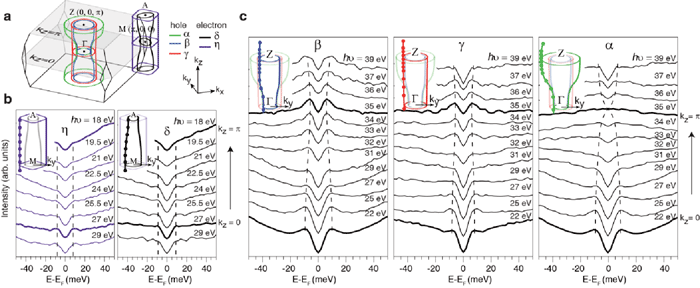
The Fermi surface of BaFe2(As0.7P0.3)2 is shown in Fig. 1a. There are three hole Fermi surface sheets (FSs) (, and ) surrounding the central –Z axis of the Brillouin zone, and two electron FSs ( and ) around the zone corner. By changing the photon energy and acceptance angle, one could investigate the momentum distribution of the superconducting gap on all FSs in the three-dimensional Brillouin zone. Detailed survey on the electron FSs revealed a nodeless superconducting gap with little kz dependence (Fig. 1b). However, for the hole FSs, the experimental data clearly shows a zero superconducting gap or nodes located around the Z point (Fig. 1b).
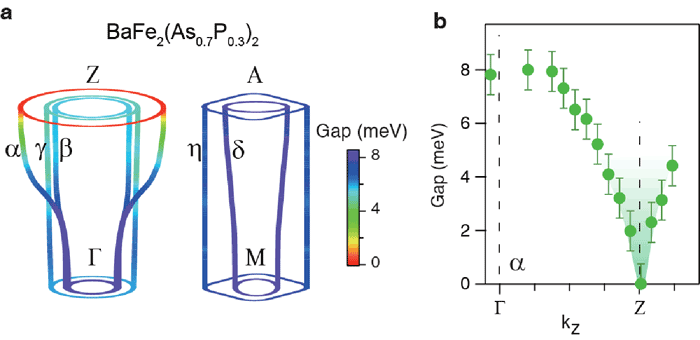
The gap distribution of BaFe2(As0.7P0.3)2 is summarized in Fig. 2. Such a horizontal line-node distribution immediately rules out the d-wave pairing symmetry, which would give four vertical line nodes in the diagonal directions ( = ± 45◦, ± 135◦), as in the cuprates. The horizontal ring node around Z in BaFe2(As0.7P0.3)2 is not forced by symmetry, as it is fully symmetric with respect to the point group. Therefore, it is an "accidental" one, which is probably induced by the strong three-dimensional nature of the band, for example, its sizable d3z2−r2 orbital character near Z (5, 6). These findings rule out a d-wave pairing origin for the nodal gap, and establish the existence of nodes in iron-based superconductors under the s-wave pairing symmetry.
Primary Citation
Y. Zhang, Z. R. Ye, Q. Q. Ge, F. Chen, Juan Jiang, M. Xu, B. P. Xie and D. L. Feng*, Nodal superconducting-gap structure in ferropnictide superconductor BaFe2(As0.7P0.3)2, Nature Physics, doi:10.1038/nphys2248 (2012).
References
- Y. Zhang, et al., Nature Mater. 10, 273–277 (2011).
- P. Richard, et al., Rep. Prog. Phys. 74, 124512 (2011).
- K. Hashimoto, et al., Phys. Rev. B 81, 220501 (2010).
- J. Hirschfeld, et al., Rep. Prog. Phys. 74, 124508 (2011).
- K. Suzuki, et al., J. Phys. Soc. Jpn 80, 013710 (2011).
- Y. Su et al., arXiv, 1110.0695 (2011).


