 |
 |
 |
 |
 |
|
 |
|
 <
/a> <
/a> |
|

 |
Core Level Spectroscopy
Introduction
Core level spectroscopy provides a method to study the chemical
state, local geometric structure, nature of chemical bonding, and dynamics
in electron transfer processes centered around one atomic site via the
mechanisms of x-ray induced core hole
creation and decay.
|
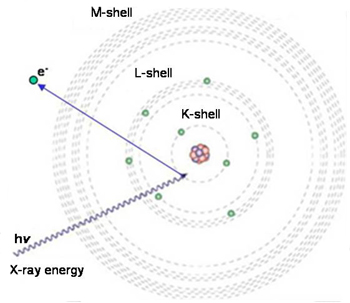
The ejection of a core electron is initiated
by the absorption of an x-ray photon (produced by synchrotron radiation)
with energy tuned to the electron's ionization as shown
here. |
 |
How is the ejection of a photoelectron related to the different spectroscopic techniques?
|
|
|
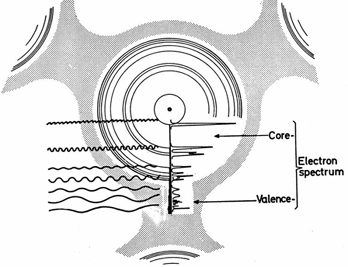
How
can we use these techniques to gain important information about model
systems?
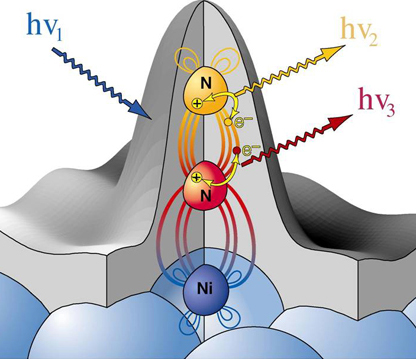
Here's an example... To the right is an illustration of the local probing character of core level spectroscopies applied to N2 adsorbed on Ni(100). The grey area represents the charge density outside the metal surface with a cut into the molecular adsorbate. Electronic transitions between core and valence electrons are indicated with arrows. Click here to see the XPS, XAS, XES, and AES spectra for this system. |
 |
back to top

