 |
 |
 |
 |
 |
|
 |
|
 |
|

 |
|
Spectroscopic Techniques
| X-ray Photoelectron (XPS) | X-ray Absorption (XAS) | X-ray Emission (XES)< /a> | Auger Electron (AES) |
|
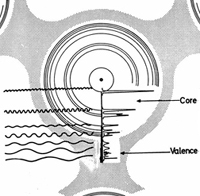
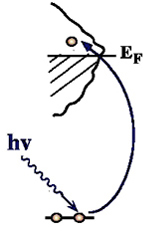
Core
holes are created by
the ionization of a core electron in XPS and
by excitation in XAS. |
 |
| CREATION OF CORE HOLES |
X-ray Photoelectron Spectroscopy
(XPS)
 |
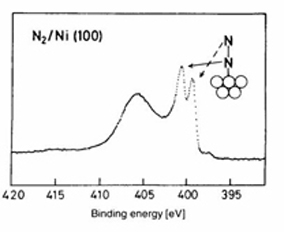 |
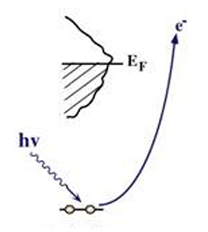
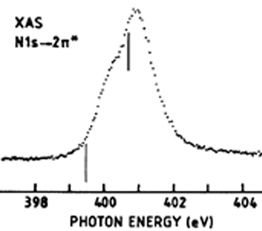
XPS is based on the creation of a core hole via ionizatio n and provides a method to study the geometric, electronic and chemical properties of a sample. In XPS, photons with sufficient energy hn are absorbed by a system causing core electrons are ejected from the sample. If the energy of the photons, hn, is larger than the binding energy of the electron (Eb), the excess energy is converted to kinetic energy of the emitted photoelectron (Ek). Knowledge of the incoming photon (hn) energy and the work function of the spectrometer (f) and measurement of the kinetic energy via an electron analyzer makes it possible to calculate the binding energy: Eb = hn + Ek + f. Since binding energies of core electrons are characteristic for elements in a certain chemical environment, XPS allows for a determination of the atomic com positions of a sample or the chemical state of a certain element, as well as electronic structure and band structure. In many cases chemical shifts can be used to draw direct conclusions on the local coordination in a system and the electronic change upon adsorption. This information can be used to distinguish different adsorption sites of molecules adsorbed on a surface as shown above right in the XPS spectrum for N2 perpendicularly adsorbed on a Ni(100) surface. Here two well-separated N 1s peaks are observed with a chemical shift of 1.3 eV. The peak with the lowest binding energy, 399.4 eV, corresponds to ionization of the outer N atom, whereas the high binding energy peak at 400.7 eV is due to ionization of the inner N atom. No such clear splitting is observed in the XAS below. |
|
back to top
down to XAS, XES, AES< /a>
X-ray Absorption Spectroscopy (XAS)
 |
 |
 |
|
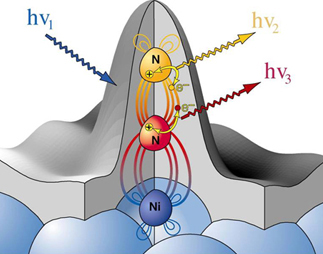
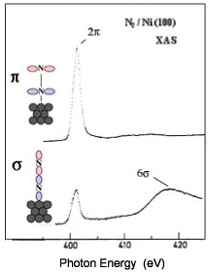
The figure at the center above is a enlarged view of the p-bonding network obtained using XAS. The total intensity of the spectrum is given by the number of unoccupied states in the inital state, while the spectral shape reflects the density of states for t he core hole state. In this way XAS provides element-specific information about the density of states, local atomic structure, lattice parameters, molecular orientation, the nature, orientation, and length of chemical bonds as well as the chemical state of the sample. Due the localization of the core hole created at a certain atom, the unoccupied states are projected on this atom. In the soft X-ray regime (K-edges of C, N, O), NEXAFS transitions are governed by dipole selection rules and consequently the absorption cross-sections shows a polarization dependent angular anisotropy. By means of polarization dependent NEXAFS measurements it is therefore possible to determine th e orientation of molecular adsorbates. Molecular orientation for N2 adsorbed on Ni (100) obtained using NEXAFS is illustrated illustrated above right. In systems with inequivalent atoms of the same element, the XA spectrum can become complicated due to overlapping spectral features. The energy separations between these are usually small and the hape and intensity of the spectral components may vary significantly, precluding a straightforward separation. However, with the help of Auger Electron Spectroscopy (AES), an XA spectrum can be decomposed into its individual components. |
||
back to top
up to XPS
down to XES, AES
| DECAY OF CORE HOLES |
X-ray Emission Spectroscopy (XES)
 |
 |
|
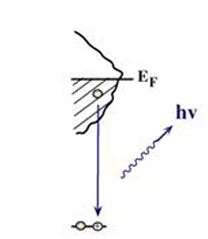
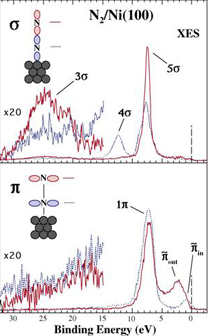
In case of highly oriented systems, e.g. the case of N2 standing up on Ni(100) shown above,angular dependent XES enables the separation of states of different symmetry of the involved orbitals. An important consequence is one can study states of symmetry which results solely from the chemical bonding. The maximum x-ray emission is generally found in the direction perpendicular to the spatial orientation the involved atomic p-orbitals. By switching the direction of detection from normal to grazing emission orbitals of different spatial orientation are probed. In normal emission geometry, only valence states of p-symmetry contribute to the x-ray emission signal, whereas in grazing emission geometry both p- and s-orbitals are probed. A simple subtraction procedure reveals s stat es only. |
|
back to top
up to XPS, XAS
Auger Electron Spectroscopy (AES)
 |

|
| After a core electron is ejected,
the ionized atom is in a high excited state. In
the Auger process, one electron falls from a higher level to fill
an initial core hole in the K-shell and the energy liberated in this
process is simultaneously transferred to a second electron ; a fraction
of this energy is required to overcome the binding energy of this
second electron, the remainder is retained by this emitted Auger electron
as kinetic energy. Unlike the one hole final state
of XES, Auger decay leads to a two-hole state under
emission of an Auger electron.
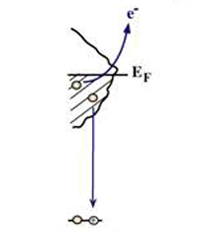
In general, since the initial ionisation is non-selective and the initial hole may therefore be in various shells, there will be many possible Auger transitions for a given element - some weak, some strong in intensity. AUGER SPECTROSCOPY is based upon the measurement of the kinetic energies of the emitted electrons which is independent of the mechanism of initial core hole formation. Each element in a sample being studied will give rise to a characteristic spectrum of peaks at various kinetic energies as seen above for N2 on Ni (100), where we see separation of the N 1s XAS 2p resonance for N2/Ni(100) into absorption peaks from the inner and outer atoms, respectively. In this way, AES allows not only for a quantiitative compositional analysis of the surface of interest, but allow provides a tool to separate the two XA features for the two inequivalent N2 atoms in m ore detail. Since the shapes and intensities of these subspectra are not a priori known this couldn not have been done by a direct analysis of the absorption spectra. |
|
back to:
top
Core Spectroscopies Introduction
Creation and Decay of Core Holes