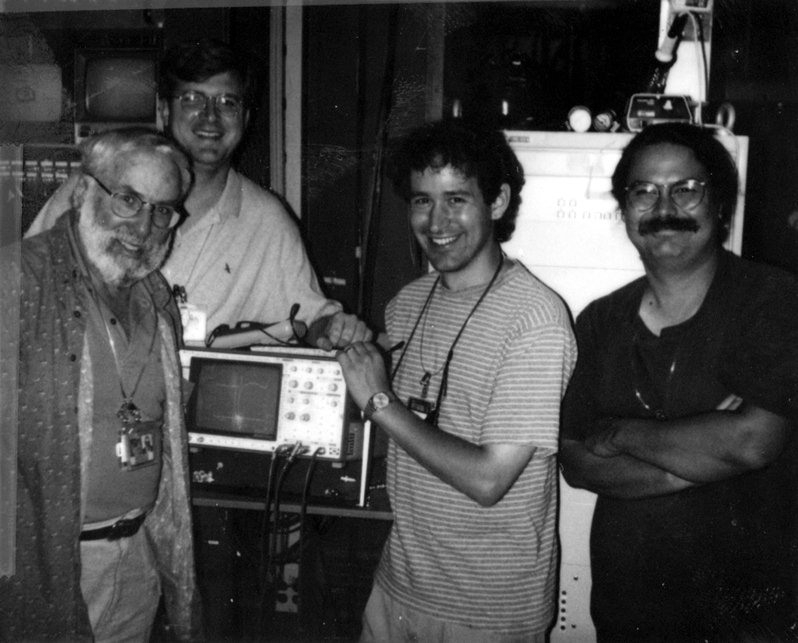

Late in the night of July 19, 1997 a new accelerator began operation at SLAC -the Gun Test Facility (GTF) located in the shielded vault of the SSRL injector linac. Graduate students Mike Hernandez and David Reis along with SSRL's John Schmerge and Herman Winick witnessed the first glimmer of light produced by an approximately 4 MeV electron beam on a phosphor screen. The GTF is an R&D facility aimed at developing the high-brightness electron source that will be needed for future linac-based X-ray free-electron lasers (FELs) such as SLAC's proposed Linac Coherent Light Source (LCLS).
The LCLS requires a high-brightness electron source to reach saturation down to 1.5 Å wavelength in a single pass through a 100 m long undulator. Electron beam brightness is a measure of the concentration of the beam and is exactly analogous to photon beam brightness. The product of the beam transverse size and divergence is called the geometric emittance. The lower the emittance, the higher the brightness. Since the divergence angle is reduced as the particle is accelerated, the normalized emittance, which does not vary with energy, is defined as the product of the geometric emittance and the dimensionless electron energy (Lorentz factor). In the current LCLS design the source must produce a beam with at least 1 nC of charge per 10 picosecond or shorter pulse with no greater than 1 pi mm-mrad normalized rms emittance. A 3.5 kA, 1.5 pi mm-mrad normalized emittance beam would be delivered to the wiggler after acceleration approximately 15 GeV in the last third of the SLAC linac using two magnetic bunch compressors at 0.3 and 6.5 GeV. This emittance is approximately the diffraction limit for 4 Å (3 keV) photons and can also be used to drive a single pass FEL such as the LCLS at even shorter wavelengths. An increase in brightness would allow the use of a shorter wiggler at substantial cost savings.
The most promising technology to date for the required source is the emittance-compensated photocathode RF gun, pioneered at Los Alamos National Laboratory (LANL) in the 1980's. In such a gun, electrons are generated by the photoelectric effect, rather than by thermionic emission (electrons boiled off the cathode surface with applied heat) as is done in the SSRL injector gun. Therefore, a high peak power, near IR laser with roughly 1 picosecond long pulses has been assembled at the GTF. This laser is frequency-quadrupled into the UV (263 nm wavelength) before the beam strikes the cathode so that the photons have sufficient energy to overcome the work function of the copper cathode currently in use.
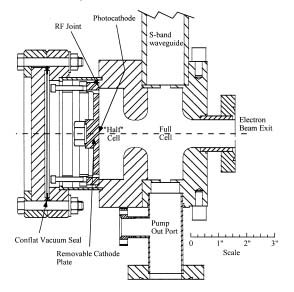
The GTF laser is designed to have sufficient energy to produce up to 2 nC (nominally 1 nC) of charge with a copper cathode. With so many electrons packed so closely together in space and time their mutual repulsion results in a spreading out of the beam; i.e., an increase in emittance and a reduction in brightness. However, the self-induced magnetic field from an electron beam confines the electrons and would exactly cancel the electric field repulsion if the beam could travel at the speed of light. Thus, the electron beam is accelerated as quickly as possible to reduce the time during which this spreading, or emittance degradation, can take place. The GTF gun photocathode is immersed in a high-gradient (up to about 150 MeV/m) accelerating field which boosts the emitted electrons to nearly the speed of light (6 MeV) in a distance of about 8 centimeters. This acceleration is done in a 1.6 cell S-band RF structure similar to that used in the SLAC linac. The residual spreading is further reduced, or compensated, by refocusing the beam emerging from the gun structure using a solenoid magnet. Hence the electron source is called an emittance-compensated photocathode RF gun.
A collaboration led by Herman Winick which includes SLAC, Brookhaven National Laboratory (BNL) and the University of California at Los Angeles has designed and fabricated an emittance-compensated photocathode RF gun aimed at meeting the demanding requirements for the LCLS. Dennis Palmer of SLAC, a graduate student of Roger Miller, played a major role in the design and initial testing of the first copy of this gun at BNL as part of his Stanford Ph.D. thesis. A second copy, with some modifications made by SSRL's Jim Weaver, has now been installed on the GTF for more detailed characterization. A critical component of the GTF is the 10 MW few picosecond long laser which drives the gun. The laser system for the GTF was designed, constructed, and is now being commissioned by University of Rochester graduate student David Reis under the supervision of Professor David Meyerhofer. It makes use of part of the laser system developed by the Rochester group for SLAC experiment E144 at the Final Focus Test Beam. The GTF diagnostics were designed, built and are now being commissioned by SSRL graduate student Mike Hernandez under supervision of Professor Helmut Wiedemann. A group at Argonne National Laboratory is also collaborating with the GTF. All technical aspects of the construction, commissioning and the continued experiments at the GTF are coordinated by John Schmerge of SSRL.
The best measured emittance to date with 1 nC of charge is approximately 2 pi mm-mrad at both BNL and LANL using emittance-compensated photocathode RF guns. Simulations of the GTF gun indicate that it is possible to produce an electron beam with an emittance of 0.9 pi mm-mrad emittance and 1 nC of charge. In order to produce this low emittance, careful shaping of the laser pulse both longitudinally and transversely is required. The reduction in emittance with this laser pulse shaping as well as full gun characterization as a function of the major input parameters is currently the main focus of research at the GTF. Generating high brightness electron beams and preserving their brightness during transport, acceleration, and compression, are major areas of R&D for future facilities for both the synchrotron radiation and high energy physics user communities, the two constituencies which SLAC serves. Thus SLAC, with its strong accelerator physics capabilities and unique experience with the SLC is the ideal place to pursue this R&D.
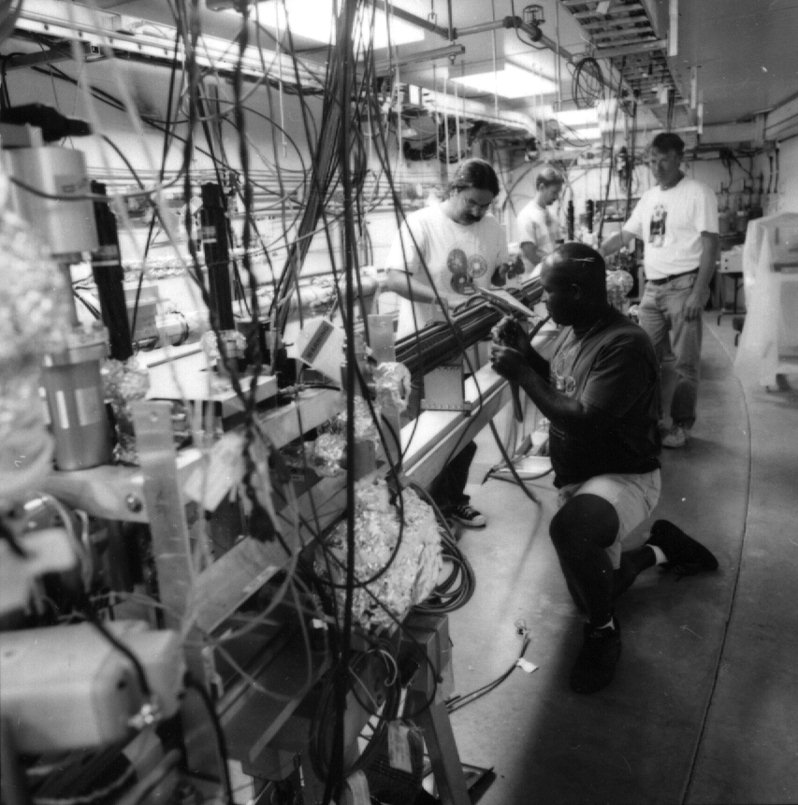
In addition to those mentioned above, many at SSRL and SLAC contributed to the design and construction of the GTF, particularly Mike Nalls, Gary Woodcock, Sam Park, Dennis Palmer and Dian Yeremian, plus many others in the machine shops, radiation physics group, SPEAR operations group, and the SSRL Mechanical Services and Electronics groups. Finally, both the SLAC and SSRL Business Services Division provided much needed assistance during procurement of the many sub-systems of the GTF.
 |