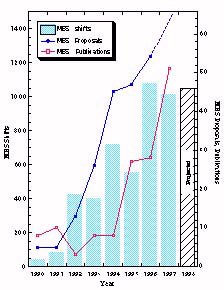

Synchrotron-based techniques have proven to be essential tools for solving problems in environmental science, such as the characterization of metal ion speciation in heterogeneous natural materials and probing structure-reactivity relationships of molecular species at environmental solid-liquid-gas interfaces. Synchrotron-based spectroscopic and X-ray scattering measurements have also become increasingly important for characterization of high-level radioactive wastes and engineered waste forms. The usefulness of XAFS and micro-XAFS spectroscopy, among other synchrotron-based methods, has driven the growth of a new interdisciplinary field, Molecular Environmental Sciences (MES), and has stimulated rapid increases in demand for MES beamtime and facilities at SSRL and other U.S. synchrotron light sources.
In the past year SSRL has taken several significant steps to provide increased support for its large and growing MES user community. On January 17 and 18, 1997, a working group of MES scientists and engineers from SSRL, other U.S. synchrotron sources, universities, and national labs met at SSRL to discuss the types of MES research being undertaken at synchrotron light sources, to document the rapid increase in demand for beamtime by MES users, to take inventory of US synchrotron facilities currently available for MES research, and to predict the future facility and infrastructure needs of the MES community at synchrotron light sources. It was concluded that current and planned U.S.-DOE synchrotron facilities should be adequate in the near future, i.e., 1997 and 1998. Beyond this time frame, however, it was anticipated that additional MES synchrotron facilities will be needed, due to projected increases in the use of synchrotron-based spectroscopic and X-ray scattering methods in applied environmental research and engineering efforts, such as routine environmental monitoring and remediation programs. MES operations and user support models were also discussed, and recommendations were made for future facilities. A report of this DOE-sponsored workshop can be obtained from Todd Slater (slater@slac.stanford.edu).
In December, a new staff scientist, John Bargar, was hired to assist in MES user and laboratory support and to conduct MES research. Subsequently, a commitment has been made by DOE to provide funding for technical and support staff for operating BL 11 and associated experimental facilities, including the hazardous sample experimental enclosure, a new state-of-the-art 30-element Ge array detector, and other instrumentation. The new detector will be equipped with a digital signal processing (DSP) system, which will provide substantially greater data throughput and processing capabilities than an analog spectroscopy amplifier. Extensive tests of the DSP system have been performed by Paola de Cecco (SSRL Biotechnology group) at SSRL beamlines using existing 13-element detectors. The results suggest that DSP should be robust and user-friendly.
On the beam line 11 front, the capital equipment project is proceeding despite some technical difficulties. During the summer 1997 shutdown of SPEAR, the beam line 11 front-end components were installed along with many of the in-alcove components. The remaining in-alcove items are scheduled for installation during the Christmas shutdown. Notably absent from the components installed this summer are the 26 pole wiggler and its vacuum chamber. The installation delay was necessitated when the vendor, Danfysik, found that oxidation initiated during the magnet block manufacturing process resulted in magnet block fragmentation into the constituent sub-blocks. (Typically, insertion devices requiring large magnetic blocks utilize composite blocks composed of several smaller magnetic blocks glued together. Composite blocks generally provide better magnetic performance at the price of increased assembly complexity and potential for adhesive failure. Ironically, the oxidation of the wiggler blocks resulted from a processing step used in the application of an anti-corrosion coating on the blocks.) This setback necessitated refabrication of all the magnetic blocks by the magnetic material subcontractor, Vacuumschmelze. After extensive environmental testing of several glues and anti-corrosion coatings, a suitable adhesive and anti-corrosion coating has been selected. The wiggler is now on track for delivery to SSRL in early 1998. Rather than interrupt SPEAR operations during the run, the insertion device will be installed during next summer's shutdown.
 |