Overview
We are interested in probing and controlling material properties on nanometer (nm) lengthscales, and how these properties evolve on femtosecond (fs) timescales following excitation. We are particularly interested in materials for future information technology applications. By probing fundamental electronic properties with x-rays, we gain information on the chemical, charge and spins states within the material. The unique x-ray sources at SLAC, the Stanford Synchrotron Radiation Laboratory (SSRL) and the world's first x-ray free electron laser, the Linac Coherent Light Source (LCLS), enable studies on the ultra-fast time and ultra-small length scales.
Controlling Spin Excitations
Recent developments have shown increasing evidence that new electronics based on electron spins, i.e. spintronics, are a compelling candidate for next generation electronic devices, both for storage and computation. Using advanced pump-probe x-ray microscopy techniques developed in the group, we are studying a variety of spin-injection based devices with the goal of delivering insights by seeing the nanoworld moving at a picosecond pace. We are also now investigating the spin waves emitted by these devices, as implementing spin-wave transistors and other logic elements could lead to low-power information processing applications based on spin waves (magnons) in the emerging field of magnonics.
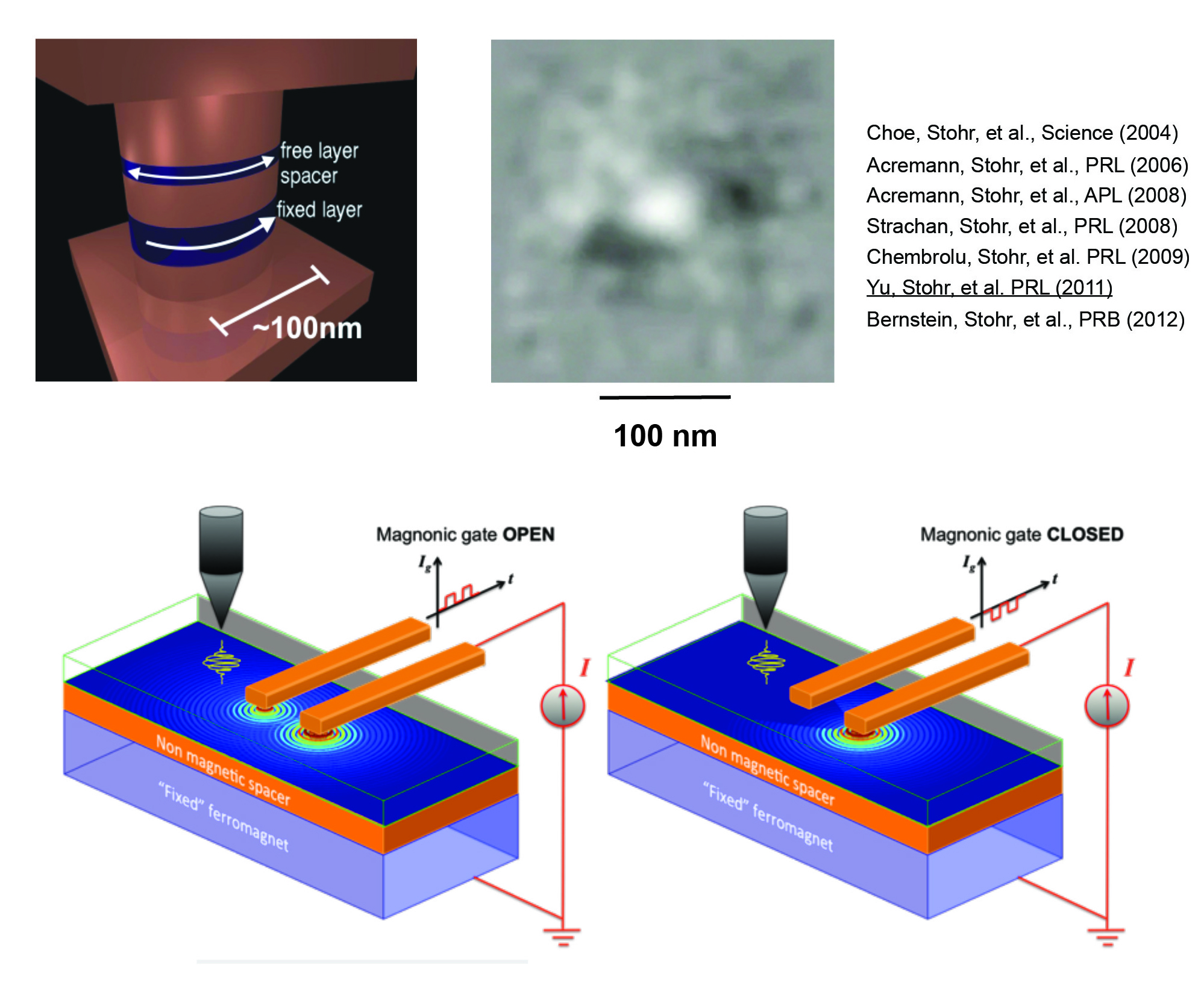
Top: Schematic and STXM image of magnetic nanopillar where current is driven through the pillar to reverse the direction of the free layer. Bottom: Schematic of spin wave device.
While the electronic control of spins has immediate implications for modern devices, of potentially greater impact is the control of spins by laser pulses. Optical laser manipulation of spins, which can respond on the fs timescale, was first demonstrated in 1996, and is still being understood. Since its first observation, materials such as the ferrimagnetic alloy GdFeCo have emerged which demonstate magnetization reversal following optical laser excitation. Most recently, we have shown with x-ray scattering in GdFeCo that angular momentum is transferred laterally and nonlocally between Fe and Gd spins following laser excitation.
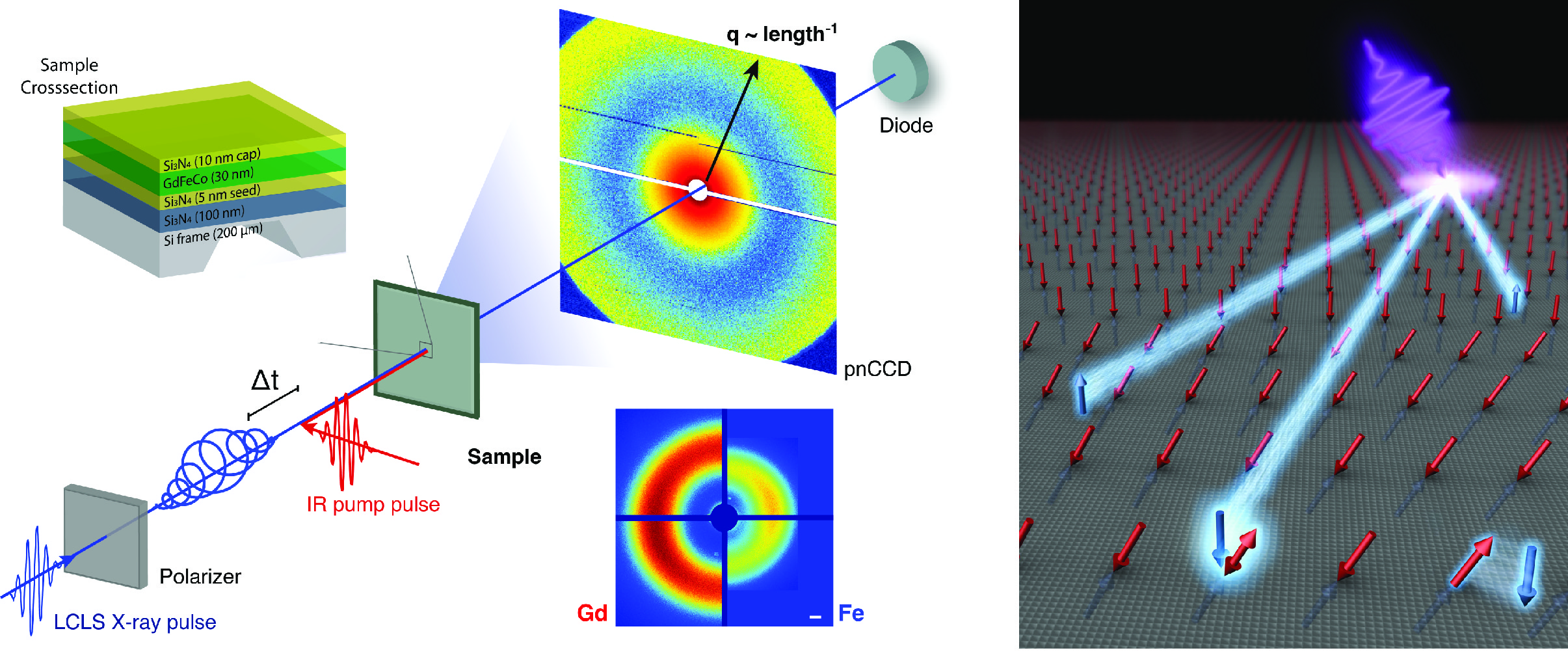
Left: Schematic of optical-pump x-ray probe scattering experiment on GdFeCo. Single-shot x-ray pulses are captured on the pnCCD detector. Data of respective scattering rings for Gd atoms and Fe atoms is shown below, indicating the different correlation lengths in the sample for the two atomic species. Right: Schematic of angular momentum transfer following optical laser excitation.
THz control of emerging Electronic Order
Strongly correlated materials display a dazzling interplay between electronic and lattice degrees of freedom giving rise to spectacular functional properties such as metal-insulator transitions, high-temperature superconductivity and colossal magneto-resistance. When metallic electrons localize they often order and distort the lattice. We are disentangling this behavior with time resolved x-ray scattering (Pontius, et al., APL 98, 182504 (2011)). Short, intense THz pulses possibly allow us to switch the electronic state of a material without heating via Zener tunneling. The fs x-ray pulses of LCLS can be used to follow the subsequent emerging electronic order. Ultimately, we aim at establishing transition-metal oxide electronics based on electric field driven metal-to-insulator phase transitions as one of the most promising avenues towards energy efficient field-effect transistors.

Left: THz excitation of VO2 with a Au metamaterial to enhance the electric field intensity. The THz field induces the metal-to-insulator (MIT) transition. Right: Schematic of FET device.
Non-linear X-ray Techniques
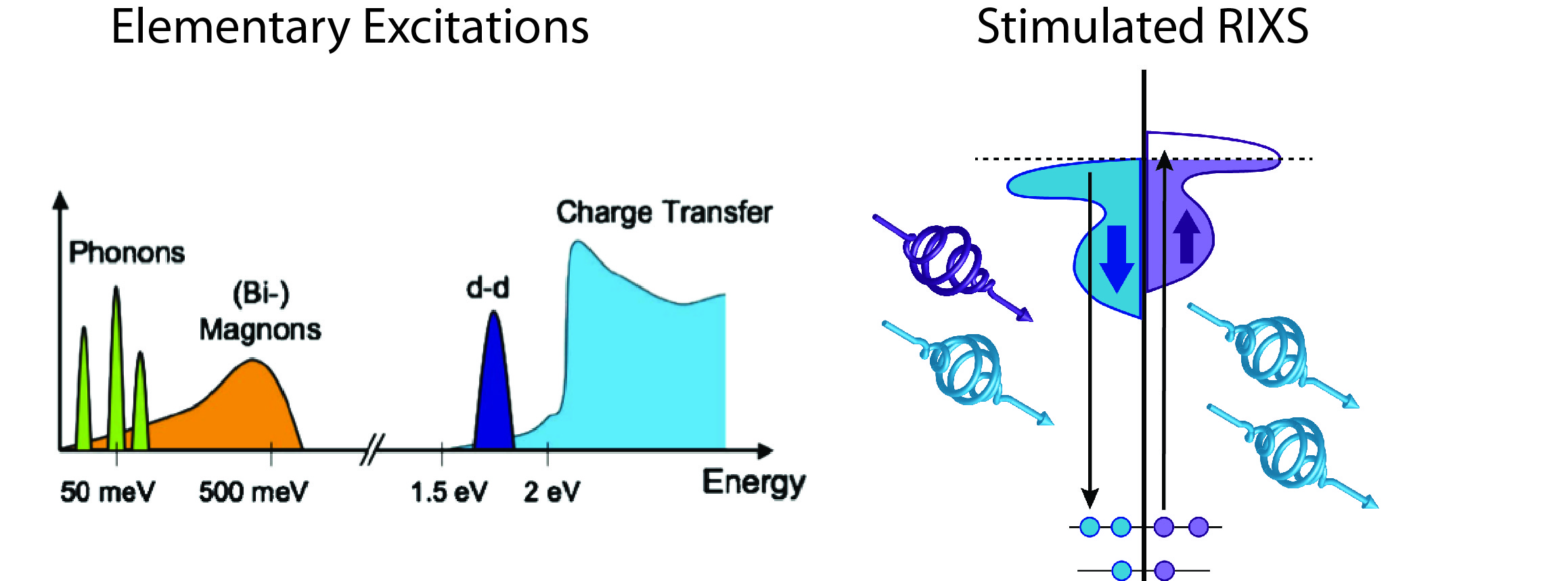
With the world's first x-ray laser next door, the development and use of novel x-ray techniques has become one of our newest projects. While there have been initial demonstations of inelastic, stimulated processes in the atomic gas regime at LCLS, we seek to utilize the intense, fast x-ray pulses for studying material properties. A key goal is demonstrating resonant inelastic x-ray scattering (RIXS) at LCLS, as this is a critical tool for studying low-energy spin excitations in emerging states.