

Solar power is an important component of our society’s future energy portfolio.1 In particular, photovoltaic devices composed of solution-processable organic materials may enable the wide-spread implementation of solar energy by dramatically decreasing device fabrication and manufacturing costs, albeit at lower power conversion efficiencies. Critical to the development of efficient organic photovoltaic devices is basic knowledge of how the nanometer structure of the active layer in the solar cell can affect the light-to-energy conversion efficiency.2 Indeed, many efforts have identified processing parameters, such as the film casting conditions, to strongly affect active layer structuring, and thereby device performance.2,3 Given that state-of-the-art organic photovoltaic devices employ mixtures of conjugated polymers with fullerene derivatives as the active layer, any crystallization of either component, which critically depends on processing details, can affect the final structuring of polymer/fullerene mixtures. Thus, it has been surmised that such changes are responsible for the variations in solar cell efficiencies. Qualitatively, increases in the conjugated polymer crystallinity have been correlated to higher output currents, since increases in polymer long-range order are expected to enhance charge transport.4,5
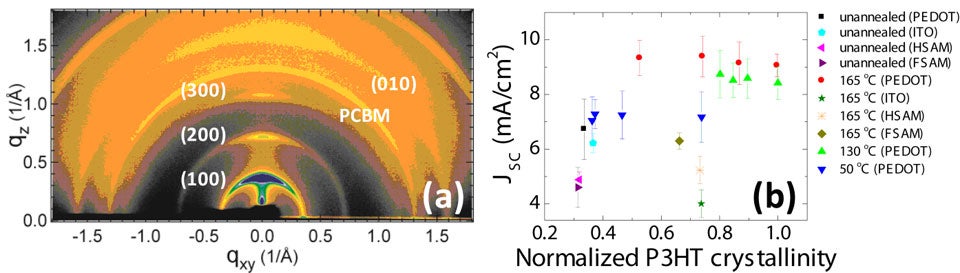
Through grazing-incidence X-ray diffraction (GIXD) experiments at SSRL Beam Line 11-3, we examined in detail the relationship between the active layer structure and output currents of organic solar cells. The combination of rocking scans and GIXD has allowed us to construct full pole figures to quantify the relative crystallinity of the polymer poly(3-hexylthiophene), P3HT, in active layers comprising P3HT and the fullerene derivative [6,6]-phyl-C61-butyric acid methyl ester (PCBM).6 Our results suggest a more complex interplay between crystallization of the constituents and device performance than previously surmised; the output currents are not strongly correlated with P3HT crystallinity (Figure 1).

However, insights into the role of structure of the active layer on device performance can be obtained by quantifying the PCBM scattering intensity. Although PCBM does not fully crystallize in the majority of our devices, the amorphous scattering intensity varies with processing conditions. We attribute increases in the PCBM scattering intensity to increases in pure PCBM aggregation. As shown in Figure 2a, the output currents of solar cells are, to first order, correlated with the scattering intensity of the PCBM. When the PCBM intensity is high, device performance is in turn dependent on the fraction of P3HT whose conjugated planes are organized along the film normal (Figure 2b).

Figures 1 and 2 highlight how the complex structuring of the constituents in the active layer can affect organic solar cell performance. Clustering of pure PCBM is important to establish efficient electron transport (Figure 3). With sufficient structuring of PCBM in place, the out-of-plane p-stacking of P3HT, which facilitates hole transport to the anode,7 plays a role in affecting output currents. Altogether, our results implicate the complexities of structure-function relationships that govern such two-component active layers and suggest that rocking curves and GIXD as a powerful combination in the pursuit of quantitative identification of the structural characteristics driving organic solar cell performance.
1. Lewis, N. S. & Crabtree, G. Basic Research Needs for Solar Energy Utilization. (US Department of Energy, 2005).
2. Thompson, B. C. & Fréchet, J. M. J. Polymer–Fullerene Composite Solar Cells. Angewandte Chemie International Edition 47, 58-77 (2008).
3. Brabec, C. J. et al. Polymer-Fullerene Bulk-Heterojunction Solar Cells.Advanced Materials 22, 3839-3856 (2010).
4. Li, G. et al. "Solvent annealing" effect in polymer solar cells based on poly(3-hexylthiophene) and methanofullerenes. Advanced Functional Materials 17, 1636-1644 (2007).
5. Erb, T. et al. Correlation between structural and optical properties of composite polymer/fullerene films for organic solar cells. Advanced Functional Materials 15, 1193-1196 (2005).
6. Baker, J. L. et al. Quantification of Thin Film Crystallographic Orientation Using X-ray Diffraction with an Area Detector. Langmuir 26, 9146-9151 (2010).
7. Sirringhaus, H. et al. Two-dimensional charge transport in self-organized, high-mobility conjugated polymers. Nature 401, 685-688 (1999).
Gomez, E. D., Barteau, K. P., Wang, H., Toney, M. F. & Loo, Y.-L. Correlating the scattered intensities of P3HT and PCBM to the current densities of polymer solar cells. Chemical Communications 47, 436-438 (2011).

