|
Related Links:
|
 |
|
|
Friday, 29 April 2005
First SPPS Results: Electro-optic Sampling and Ultra-fast Meltingsummary written by Heather Woods, SLAC Communication Office
The Sub-Picosecond Pulse Source (SPPS) collaboration has published data from
the first experiments ever using a linear accelerator-based femtosecond x-ray
source. SPPS makes the world's shortest bunches of electrons in the SLAC linear
accelerator and turns them into very bright pulses of x-ray light 1,000 times
shorter than those made in synchrotron rings like SPEAR3. SPPS has many
similarities to future free electron lasers like the Linac Coherent Light
Source (LCLS) currently being built at SLAC.
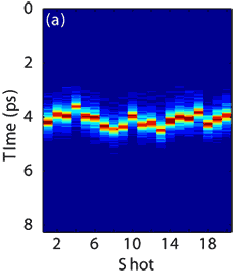
Researchers used SPPS to develop and test a new timing technique, electro-optic
sampling, which will be essential for many SPPS and LCLS experiments. To put
data in order chronologically - important for seeing chemical or other
reactions over time - researchers need to time-stamp the arrival of the laser
pulse that starts a reaction, and the arrival of the x-ray pulse that observes
the system. The strong electric field generated by each electron bunch alters
the properties of an electro-optic crystal placed next to the beam, but only at
the instant the electrons pass by. The characteristics of the laser light
exiting the crystal reveal the electron bunch length and arrival time, and thus
the x-ray pulse arrival time. In the other experiment, researchers shone laser
light to melt a room-temperature crystal of semiconductor material, and sent
x-ray pulses to probe the material. The scattered x-rays provided the first
look at the first few femtoseconds in the transition from solid to liquid. In
that time, the atom positions had on average the initial crystalline (regular,
repeated) structure of the solid, yet the atoms had moved far from their
starting positions, with the disordered structure of a liquid. The result is a
very unusual, intermediate state of matter.
Many authors contributed to this research. Full author lists
for the associated papers can be found in the reference section in the
technical science highlight
|