|
Related Links:
|
 |
|
|
Monday, 29 March 2005
Understanding the Mysteries of High-Temperature Superconductorssummary written by Heather Woods, SLAC Communication Office
Donghui Lu, Kyle Shen and Zhi-Xun Shen
Departments of Applied Physics, Physics, and Stanford Synchrotron Radiation
Laboratory, Stanford University, Stanford, CA 94305
High-temperature superconductors (HTSCs) operate in mysterious ways, but
scientists are starting to understand their peculiarities by using a
state-of-the-art spectroscopy system at SSRL. One of the biggest mysteries is
how a material that starts as an insulator-which does not conduct
electricity-can become a high-temperature superconductor after being doped with
electric carriers. Researchers Kyle Shen and Donghui Lu (both SSRL), working in
Zhi-xun Shen's group at SSRL and Stanford, looked at the evolution from
insulator to superconductor by studying an HTSC material at different doping
concentrations. The team used angle-resolved photoemission spectroscopy
(ARPES), a method of probing the electronic states in solids.
Their results, published in Science Feb. 11, contribute to creating a
fundamental understanding of the perplexing physics in the mysterious HTSCs.
Scientists hope to develop a theory explaining why the materials can be
superconducting at a temperature much higher than conventional superconductors,
and thereby how to improve the materials, currently too brittle for widespread
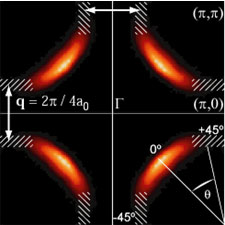
use. The ARPES data revealed electronic states in the two-dimensional momentum
space that are much stronger along the direction diagonal to the copper-oxygen
bond (the "nodal" direction) than the direction parallel to the copper-oxygen
bond (the "anti-nodal" direction), even through the anti-nodal direction is
where the superconducting gap is the largest. The results show that the
difference in momentum directions is important to the electronic structure, and
put strong constraints on proposed HTSC models.
|