|
Related Links:
|
 |
|
|
Monday, 28 February 2005
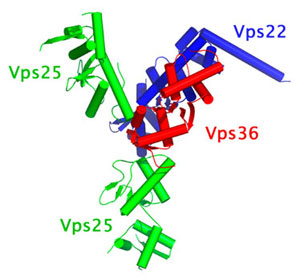
Structure of the ESCRT-II Endosomal Trafficking Complex
Aitor Hierro1, Ji Sun2, Alexander S.
Rusnak2, Jaewon Kim1, Gali Prag1,
Scott D. Emr2 & James H. Hurley1
1National Institute of Diabetes and Digestive and Kidney Diseases,
National Institutes of Health
The lysosome is the "digestive system" of an animal cell. Molecules taken up
from the outside are sent to the lysosome to be broken up into a form that can
be safely used by the rest of the cell. A network of membrane vesicles called
the endocytic pathway moves cargo destined for the lysosome from the surface of
the cell. One of the last steps before the cargo reaches the cell is the
pinching-off of small vesicles into the center of a big vesicle. When the big
vesicles join the lysosome by fusion, the small vesicles inside it are
released into the lysosome and broken down by powerful degradative enzymes. The
stage where small vesicles reside inside the bigger vesicle is called a
"multivesicular body" (MVB). The machinery for making MVBs is hijacked by the
HIV virus to escape from cells and is considered a potential target for HIV
therapeutics. In its normal functioning, the MVB machinery breaks down proteins
that can cause cancer when they are present in excess. Using x-ray diffraction
data collected at the APS and SSRL Beam Line 9-2, collaborators from the NIH
and the University of California at San Diego have determined the first
structure of an ESCRT complex.
|
||||||