|
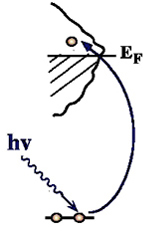
In X-ray Absorption spectroscopy, a core electron is excite
d into
an empty valence state above the Fermi level by the absorption
of a x-ray photon with energy tuned to the ionization energy of
the electron. This event occurs when the excitation energy of
the photoelectron is not high enough to reach the ionization continuum.
The XAS spectrum
records the absorption intensity as a function
of the incoming
photon energy.
XAS is divided into two regimes; Near Edge X-ray
Absorption Fine Structure (NEXAFS) for bound states and low energy
resonances in the continuum, and Extended X-ray Absorption Fine
Structure (EXAFS) when the outgoing electron is well above the
ionization continuum. In the NEXAFS regime the spectroscopy provides
information about the empty electronic states above the Fermi
level. The
dipole selection rules (Dl = +/- 1,
Ds = 0, Dj
= 0, +/- 1) which dictate the absorption process and the p
olarization
of the synchrotron radiation allow us to probe the population
and the symmetry character of different orbitals and obtain information
about the orientation of the molecules adsorbed on the surface.
The latter case is falls within NEXAFS and is illustrated in the
figure above center.
In a one-electron
picture th
e XA spectrum reflects the unoccupied density of states
where the position of the Fermi level is porvided by the XPS core
level binding energy (see XPS above). In this way it provides
element-specific information about
the density of states, local atomic structur
e, lattice parameters,
molecular orientation, the nature, orientation, and length of chemical
bonds as well as the chemical
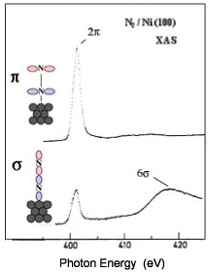
state of the sample. Molecular orientation is manifest in the
XAS spectra as shown for N2 adsorbed on
Ni(100) shown at left. The
total intensity of the XA spectrum is given by the number of unoccupied
states in the inital state, while the XA spectral shape reflects
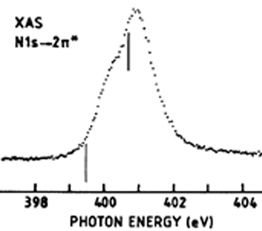
the density of states for the core hole state. An example of this
can be found above right, which is a enlarged view of the pi-bonding
network ob
tained using XAS.
|