 |
 |
 |
|
 |
|
 |
|
 |
|
 |
|
Creation and Decay of Core
Holes |
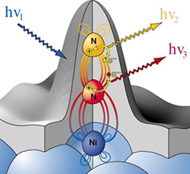
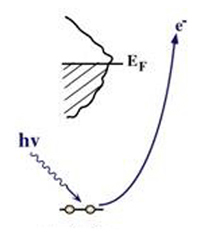
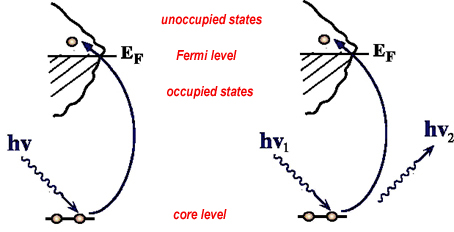
We can create a core-hole through the absorption of incoming light with energy matched to the binding energy of a core electron. This absoprtion causes the core electron to be excited to a bound state or to the continuum where it will become a free particle. The creation of a core hole by ionization forms the basis for XPS while the creation of a core hole by excitation is studied in XAS.
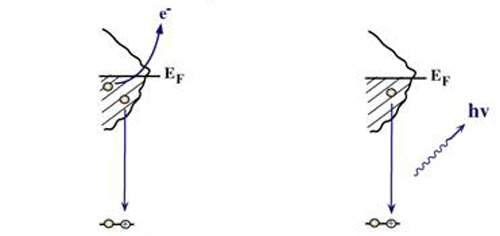
After ionization, the absorbing atom is in a highly excited state due to the creation of a core hole. The atom relaxes via the core hole decay of the photoelectron. Non-radiant dexcitation of core holes forms the basis for AES, while radiant decay is studied in XES, both of which provide tools for probing unocuppied electronic structure of a model system.
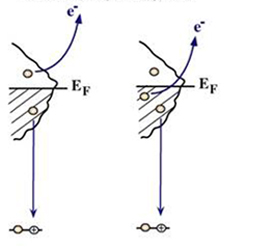
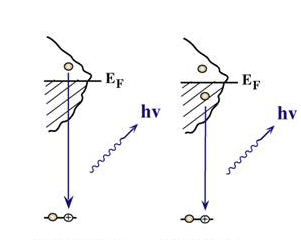
These events only consider a core-ionized initial state prior to the decay. However, an initial state with the core electron instead excited into a bound state can modify the decay process. The two steps, creation and decay, can lead to coupling and the whole process can be considered a one step event. These events are called resonant processes and can involve radiant and non-radiant decays. The excited electron can either participate in the decay process or be passive as a spectator leading to very different types of final states as shown below.
|
Creation of Core
Holes |
|
Ionization |
Excitation | ||
 |
 | ||
|
Decay of Core Holes
|
 | |
|
Non-Radiant |
Radiant |
|
Resonant Processes
|
|
Non-Radiant
Resonant Photoelectron Spectroscopy (RP ES) Resonant Auger Spectroscopy (RAES) Autoionization Spectroscopy (AIS) |
Radiant Resonant Inelastic X-ray Scattering (RIXS) Resonant X-ray Emission Spectroscopy (RXES) | ||
 |
 | ||
| Participator decay one hole final state |
|
|
|