
|
| Ultra High Vacuum Surface Science End Station |
| General description The ultra high vacuum system (UHV) for surface science experiments is connected to beam line 13-2. The instrument is mainly used to study molecules adsorbed on a substrate at UHV conditions. Examples of substrates are metal single crystals, e.g. Pt(111), Cu(110), Cu(111), Ru(0001), and Ni(100), mounted on a liquid nitrogen cooled sample rod. Two custom designed single crystals can be mounted at the same time. Cleaning of the single crystals can be performed through cycles of ion sputtering and annealing. The temperature is controlled through two separated tungsten filaments beneath each substrate and monitored through thermocouples attached on the side of the single crystals. Other examples of substrates or samples are semiconductor materials or carbon nanotubes mounted on a simple rod where the substrates or samples are clamped on a copper or a tantalum sample holder. Changing sample require breaking vacuum in the preparation chamber. A bake out procedure is therefore necessary to achieve UHV again. After sample preparation in the preparation chamber the samples are transferred into the analyzer chamber, which is equiped with an electron energy analyzer and a partial electron yield detector. A x-ray emission detector can also be added. |
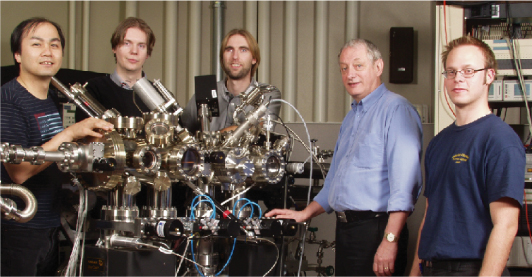 |
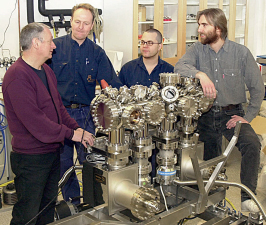
| From left to right: Hirohito Ogasawara, Henrik Öström, Lars-Åke Näslund, Jan-Olof Forsell, Klas Andersson. (photo: Lowell Martinson) |
||
|
|
||
People on the photo Building the instrument was a team work and some of the team members are shown in the photo. Hirohito was involved in the decision of the basic requirements together with Anders Nilsson (not present in the photo), Jan-Olof developed the final design, and Lars-Åke assembled the instrument with assistance from Henrik and Klas. |
|
|
||
Equipment |
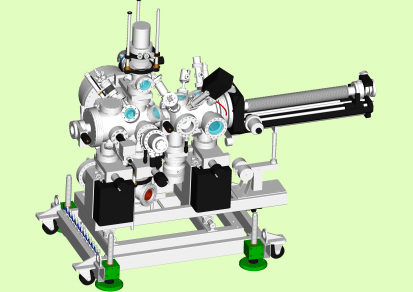
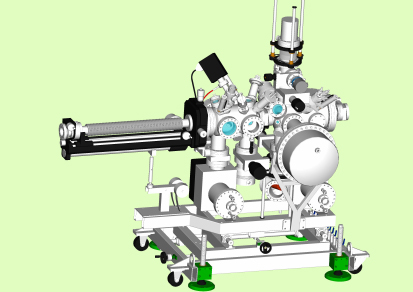
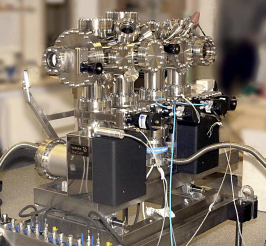
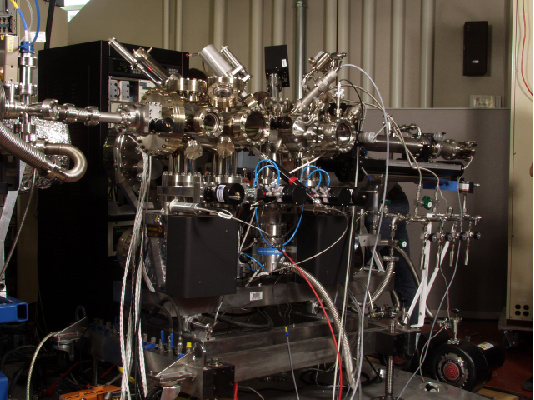
| The
soft x-ray surface science instrument consists of a main chamber (left
side in the left panel, right side in the right panel) and a
preparation chamber (in the center of the figure). The main chamber is
equiped with a Scienta R3000 electron energy analyzer for photoelectron
spectroscopy and a Partial Electron Yield detector (a multi-channel
plate device) for x-ray absorption spectroscopy. The preparation
chamber is equiped with an Omniax manipulator, ion gun, mass
spectrometer, LEED optics, and a simple load lock system. The Ultra
High Vacuum (UHV) in each chamber is maintanance through a VacIon Plus
150 StarCell in combination with a Titanium Sublimation Pump from
Varian except during sample preparation when the preparation chamber is
pump through a Turbo V-301 Navigator from Varian. The base pressure is
better than 3x10-11 torr in both chambers. |
|
|
||
Building the soft x-ray surface science instrument Below are some photos showing the developement of the soft x-ray surface science instrument. |
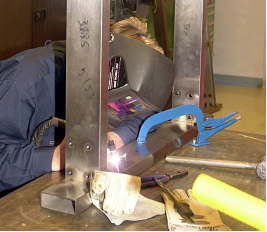 |
Fall 2001 at Uppsala University, Sweden. The frame starts to get shape. |
|
|
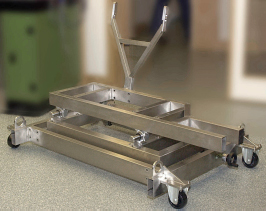
The frame is ready.
|
 |
|
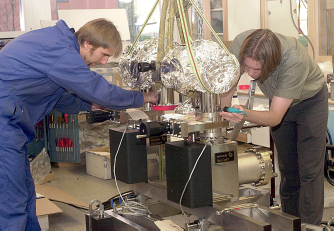 |
The ion pumps are mounted on the frame and the two chambers will soon be on place. | |
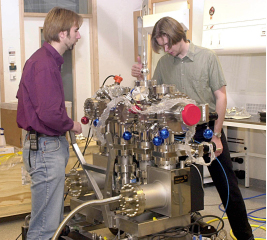
| Blind flanges are mounted on all ports to the both chambers. The instrument is now under UHV and Henrik is controlling the function of the gate valves to the pumps. |
 |
|
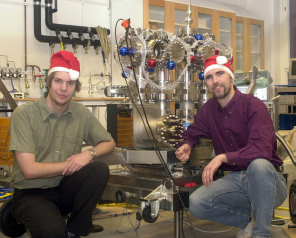 |
The photo is taken two weeks before Christmas 2001. The instrument is decorated with ornaments and a tree topper, which of course enhanced the Christmas spirit. | |
| The instrument is designed to be operated from only one side. |
 |
|
 |
Spring 2002 at Uppsala University, Sweden. The instrument is ready to be shipped to SSRL. Jan-Olof informs Dan Cajander, Fredrik Bohlin, and Lars-Åke about how the mu-metal shielding needs to be manufactured and installed in the main chamber. |
|
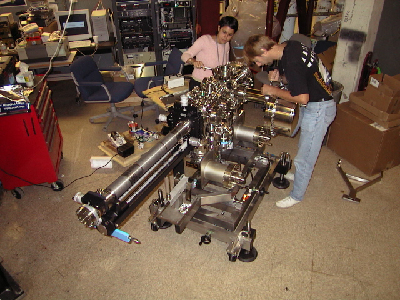
| Summer 2002 at SSRL. The instrument has arrived to SSRL together with an Omniax manipulator and a Scienta SES-100 electron energy analyzer. The manipulator is mounted and the last screws holding the SES-100 are tightened. |
 |
|
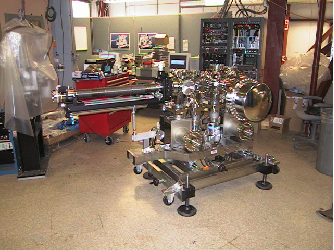 |
Before the ion gun, mass spectrometer, LEED optics, etc are installed the instrument need a high temperature bake-out to ensure good UHV-conditions. This is the last photo where the instrument is still shiny since the bake-out gave the instrument a brown tone. | |
| February 2003. The instrument is connected to beamline 11 at Advanced Light Source (ALS). The preparation chamber is now equiped with an ion gun, mass spectrometer, LEED optics, and a pulse valve for gas dosing. The main chamber is equiped with a Scienta SES-100 electron energy analyzer for photoelectron spectroscopy and a Partial Electron Yield detector (a multi-channel plate device) for x-ray absorption spectroscopy. The instrument is later transfered back to SSRL when SPEAR 3 started to deliver light 2004. |
 |
| X-ray Emission Spectroscopy Spectrometer |
| General description The x-ray emission spectroscopy (XES) detector is located in connection to beam line 13-2. The detector is mainly used to study molecules adsorbed on a substrate at both UHV and ambient conditions. The XES spectrometer can be attached to the UHV Surface Science End Station but also to other chambers, e.g. a liquid cell set up. The two gratings are optimized for high performance at the carbon and oxygen K-edge, respectively. |
|
|
||
Equipment |
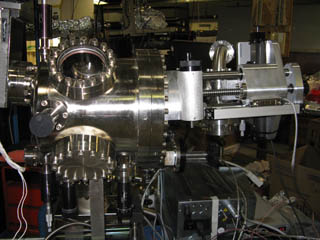
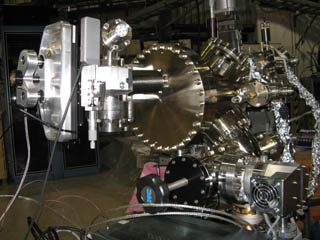
| The
x-ray emission spectroscopy detector consists of a grating chamber
(left side in the left panel, right side in the right panel) and a
detector house (rigth side in the left panel, left side in the right
panel). The graiting chamber house a revolver with two graiting mounted
- optimized for carbon and oxygen K-edge, respectively. The detector
house is equiped with a detector from VG Scienta. The Ultra High Vacuum (UHV) is
maintanance through a VacIon Plus 150 StarCell or through a Turbo V-81
Navigator from Varian. |
| Ambient Pressure XPS/XAS End Station |
| General description The ambient pressure x-ray photoelectron and x-ray absorption spectroscopy (AP-XPS/XAS) system for in situ surface science experiments is connected to beam line 13-2. The instrument is mainly used to study molecules adsorbed on a substrate at ambient conditions and to follow chemical processes at, e.g., catalytical surfaces. Examples of substrates are metal single crystals, e.g. Pt(111), Cu(110), Cu(111), and Ru(0001), or metal oxides, e.g. Fe2O3, TiO2, and MgO. The sample can be prepared in a preparation chamber and thereafter transferred into a gas cell located in the analyzer chamber. The sample is mounted on a sample rod, which also seal the open end of the gas cell. Cleaning of the single crystals can be performed through cycles of ion sputtering and annealing. The temperature is controlled through restivity heating and monitored through thermocouples attached on the side of the sample. Changing samples require breaking vacuum in the preparation chamber. A bake out procedure is therefore necessary to achieve UHV but is not required if the sample does not need ultra high cleanliness. The standard gas cell can be replaced by a custom designed gas cell optimized for experiment in mind. |