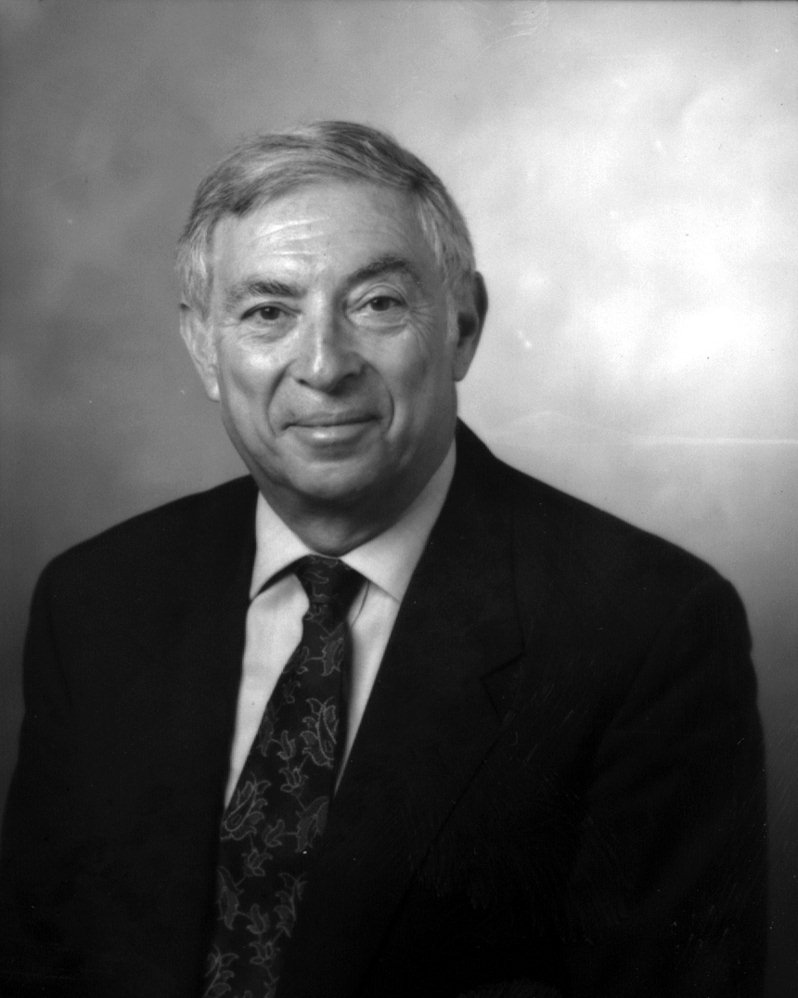

After 20 exciting and rewarding years as SSRL's director, it is time for me to step down and say good-bye, at least for a while, to those who have helped to make those years so rewarding.
It is good-bye, first of all, to the SSRL staff, faculty and directorate who have forged a superb user facility. They started at a time when there was no corresponding facility in the world to which large numbers of scientists came for short periods, week after week, to carry out experiments in a variety of disciplines. In the context of parasitic SPEAR operation, they created an atmosphere of true "welcome" in addition to providing cutting edge technical and intellectual support.
Continuing on the forefront, they created the wigglers and undulators, which seemed so extreme at their initiation, but have become commonplace now. They drove PEP to lower emittances than have been achieved yet by the third generation sources and introduced the first hard X-ray undulators.
They built an injector system for SPEAR which made it independent of the SLAC 50 GeV linear accelerator. Then, when SPEAR became fully dedicated to synchrotron radiation, they lowered its emittance and made it into an extremely reliable source. Now, they plan to reduce its emittance even further, and increase the stored current, with the SPEAR3 project.
Finally, they pursue the Linac Coherent Light Source (LCLS) project, which will make entirely new science possible.
It is good-bye and thanks, as well, to our colleagues in the other SLAC divisions, who have supported us in these endeavors. Without their foresight in adding a synchrotron radiation port to SPEAR, there would be no SSRL. They helped us, as well, to learn the many skills required to develop and operate a storage-ring based facility. Later, they greeted us cautiously, as we did them, upon the merger of SSRL and SLAC. Since then, there has been increasing cooperation and mutual support.
It is the users, of course, who make it all meaningful. I have watched with joy through the years as you have used SSRL to develop and do important science with:
Last, but not least, I must thank my graduate students and post-docs, for they have kept me alive in science and kept SSRL's scientific capabilities personally meaningful to me. Together, we played a role in the development of EXAFS as a tool for the study of amorphous alloys and then went on to develop wide angle, grazing incidence and small angle anomalous X-ray scattering for the same purpose. You were a constant source of satisfaction and pleasure. I am pleased to have you all as colleagues now.
I step down now with the sense that SSRL has a magnificent future. It is running extremely well. Good science and technology are resulting from its operation. Over the next half-decade, we can expect SPEAR3 to enhance SPEAR's performance markedly. Subsequently, we anticipate that the LCLS will take us into new realms of synchrotron radiation research, with coherent hard X-ray techniques becoming increasingly feasible and time resolved X-ray scattering and spectroscopy studies becoming feasible on the subpicosecond time scale.
As for me, I am excited about the possibility of going to Washington as Associate Director for Science of the Office of Science and Technology Policy. It is an opportunity to work for the health and vitality of all U.S. science and science education within the political system, a prospect I relish. Over the years, I have become an increasingly strong supporter of that system, which works best when people work and speak loudly for the things in which they believe. Thus, I am pleased with the prospect of becoming a more integral part of it.
I hope that all of you who are associated with SSRL will also continue to think and work with a broad view. Over the past few years, we have all seen vividly that SSRL's fate is directly linked to the health of American science. In the years between fiscal 1992 and fiscal year 1996, SSRL had all the technical capabilities to run 9-10 months per year but lacked the funding. The funding came when we combined forces with all of the Department of Energy's facilities to insure that all of them had sufficient funding to operate effectively.
Then, we faced the threat of a major cut in the funding of the Energy Research program of the Department of Energy. That cut would have devastated SSRL and a large faction of American science. Again, by joining forces with the larger scientific community, we were able to convince executive and legislative leaders that such cuts were inappropriate.
As I look to the future, I see an extremely strong synchrotron radiation community with SSRL an integral part. The only threat that this community faces to its continuing vitality and effectiveness is a decline in the health of all American science and technology. Thus, it is natural for me to want to go to Washington "to fight the bigger fight".
At the same time, I look forward to returning to research. With its high quality and full time operations, SSRL offers opportunities to understand amorphous alloys that just were not feasible when I began this directorship. Similarly, LCLS offers the opportunity to obtain detailed understanding about what is happening as materials pass through the glass transition temperature region. It will be delightful, someday, to devote myself to such studies. It was, after all, this research which led me to participate in SSRL's initiation some twenty-five years ago.
 |